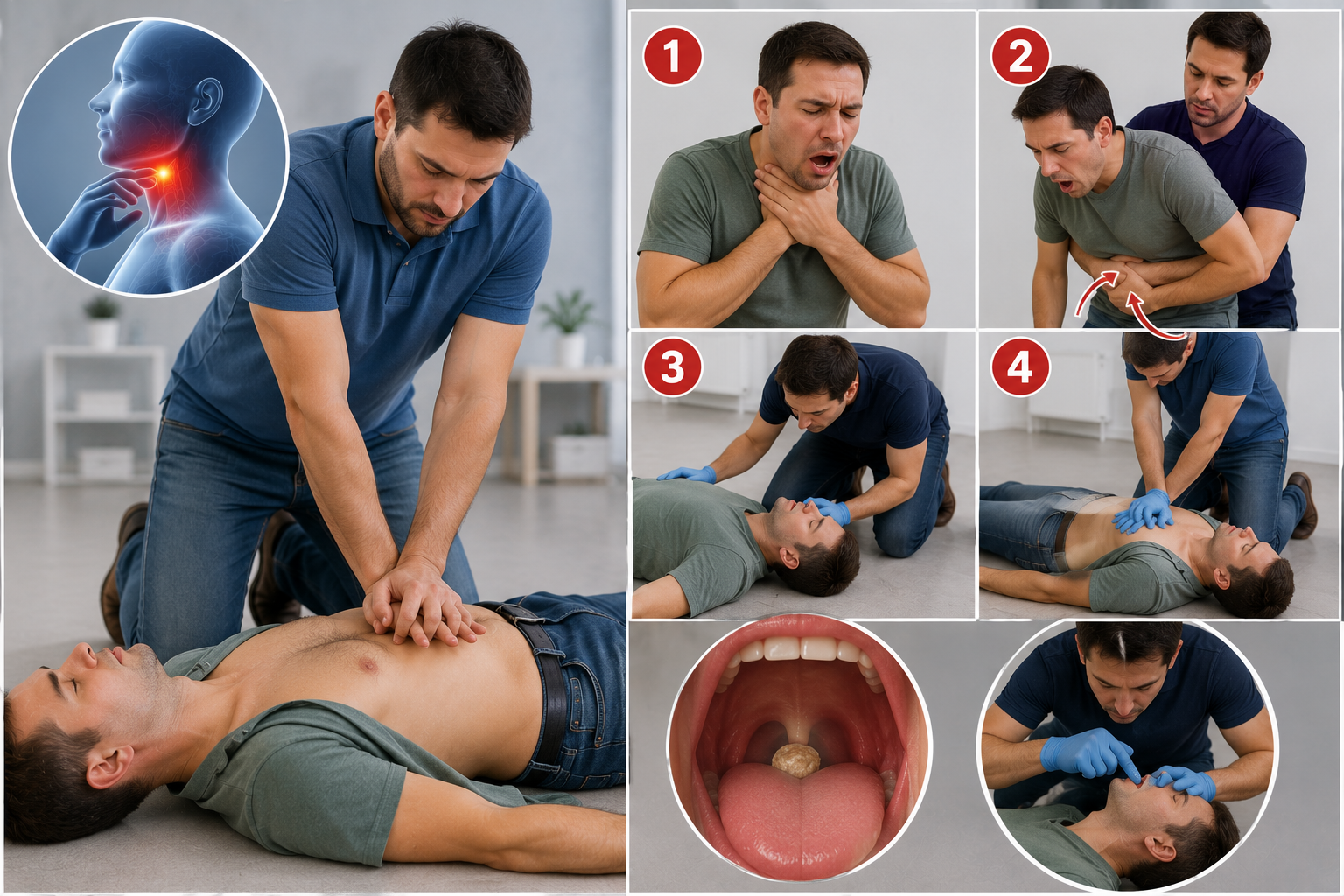
How does CPR differ in an unresponsive adult choking victim compared to standard CPR? Most bystanders freeze at this exact moment, unsure whether to keep doing abdominal thrusts or switch to chest compressions. The 2026 American Heart Association Guidelines settled this question with a clear, standalone protocol built specifically for this scenario.
This guide walks through the exact sequence rescuers should follow once a choking adult goes limp, which makes it different from routine cardiac arrest CPR, and the one critical airway check most people skip. Every step below reflects the AHA’s newest guidance, published in October 2026.
Key Takeaways
- Once a choking adult becomes unresponsive, rescuers stop back blows and abdominal thrusts and begin standard CPR starting with chest compressions.
- The key difference from regular cardiac arrest CPR: rescuers must look inside the mouth before every set of rescue breaths and remove any visible object.
- Blind finger sweeps are never recommended — they can push the object deeper into the airway.
- The 2026 AHA update introduced a standalone Adult Choking (FBAO) Algorithm, separate from the general Adult BLS Algorithm, for the first time.
- Chest compressions themselves may generate enough pressure to dislodge the object, so rescuers should not delay compressions to search for it first.
What Happens the Moment a Choking Adult Goes Unresponsive?
The instant a choking adult stops responding, the emergency shifts from an airway-obstruction problem to a full resuscitation problem. Rescuers must act within seconds, since the brain starts losing oxygen almost immediately.
According to the American Heart Association’s 2026 Guidelines for CPR and Emergency Cardiovascular Care (published October 22, 2026), rescuers should lower the person carefully to the ground, activate emergency services or send someone to call 911, and begin chest compressions right away without checking for a pulse first.
Pro Tip: Don’t waste time trying to find a pulse. Lay rescuers are not required to check for one before starting compressions — every extra second without blood flow lowers the odds of recovery.
- Call 911 immediately or direct a specific bystander to call.
- Lower the person flat onto a firm, flat surface.
- Begin chest compressions without delay.
- Send someone to retrieve an AED if one is available nearby.
How Does CPR Differ in an Unresponsive Adult Choking Victim vs. Standard Cardiac Arrest?
This is the core question, and the answer comes down to one added airway step. Standard CPR for a cardiac arrest not caused by choking never requires a mouth check, since there’s typically nothing to look for.
For a choking victim, though, rescuers must glance inside the mouth every time they open the airway to give a breath, because a visible object needs to come out before air can reach the lungs.



Warning: Never perform a blind finger sweep — sweeping a finger through the mouth without seeing the object first can push it further down the airway and make the blockage worse.
| Feature | Standard Cardiac Arrest CPR | Unresponsive Choking Victim CPR |
| Cause of collapse | Heart stops beating | Airway physically blocked |
| Mouth check before breaths | Not required | Required every cycle |
| Object removal | Not applicable | Remove only if visible |
| First action | Chest compressions | Chest compressions |
| Compression-to-breath ratio | 30:2 | 30:2 |
| Pulse check needed | No (lay rescuers) | No (lay rescuers) |
Why AHA Removed the Blind Finger Sweep Recommendation?
Older CPR training, some of it still circulating in outdated guides, once taught rescuers to sweep a finger through an unconscious choking victim’s mouth to search for the object. That advice has been retired.
Recent observational research reviewed for the 2026 guidelines found that blind sweeps risk pushing the obstruction deeper into the throat rather than clearing it, which is why the AHA now restricts removal to objects rescuers can actually see.
- Only remove an object if you can clearly see it.
- Use a finger to hook it out gently, never a full sweep.
- If nothing is visible, continue straight to rescue breaths and compressions.
The New Adult Choking Algorithm: What Changed in 2026
Before 2026, choking guidance lived inside the general Adult Basic Life Support algorithm as a smaller side note. The AHA’s newest guidelines pulled it out into its own standalone Adult Foreign-Body Airway Obstruction (FBAO) Algorithm for the first time, giving choking its own dedicated decision path from first response through the transition into CPR.
The other major shift affects conscious choking victims specifically: rescuers now start with five back blows before moving to five abdominal thrusts, reversing the old abdominal-thrust-first approach, and repeat that cycle until the object clears or the person stops responding.
Sequence for a Conscious Choking Adult (Before Unresponsiveness)
- Confirm severe choking by asking, “Are you choking?”
- Deliver 5 back blows between the shoulder blades.
- Follow with 5 abdominal thrusts (or chest thrusts for pregnant individuals).
- Repeat the cycle until the object is expelled or the person becomes unresponsive.
Sequence Once the Person Becomes Unresponsive
- Stop back blows and abdominal thrusts immediately.
- Lower the person to the ground and call 911.
- Begin chest compressions at 100–120 per minute, 2–2.4 inches deep.
- Before each set of breaths, look in the mouth and remove a visible object only.
Compression Depth, Rate, and Rescue Breath Standards for 2026
The mechanics of the compressions themselves don’t change for a choking victim — they follow the same physical standards as any adult CPR. What changes is only the airway-check step layered on top.
The 2026 AHA Guidelines maintain a compression depth of 2 to 2.4 inches and a rate of 100 to 120 compressions per minute for adults, with a 30:2 compression-to-ventilation ratio for trained rescuers before an advanced airway is placed.
Pro Tip: If you’re untrained or unsure about giving breaths, hands-only compressions are still far better than doing nothing. Continuous, uninterrupted compressions can keep blood moving until EMS arrives.
Hypothetical Example (for illustration purposes):
A man at a restaurant starts choking on a piece of steak. A bystander delivers 5 back blows, then 5 abdominal thrusts, cycling twice more as the man’s face turns dusky. He suddenly goes limp and slides out of his chair. The bystander immediately lowers him to the floor, shouts for someone to call 911, and starts chest compressions. Before the first rescue breath, she glances into his mouth, sees a visible piece of food near the front, and removes it with one finger — then continues compressions until paramedics arrive.
Note: This scenario is illustrative. Actual results vary depending on the person, the object, and how quickly CPR begins.
Why Does Bystander Response Speed Matters So Much?
Choking deaths are almost entirely preventable when someone nearby knows what to do and acts fast. The gap between knowing the old Heimlich-only approach and the current combined protocol can cost precious seconds.
According to the American Heart Association’s newsroom release accompanying the 2026 Guidelines, only about 41% of adults who experience cardiac arrest outside a hospital receive bystander CPR before EMS arrives, even though early CPR can double or triple a person’s chance of survival.
- Early recognition of severe choking saves the most time.
- Fast escalation from back blows/thrusts to CPR prevents unnecessary delay.
- Confidence from proper training reduces hesitation in the moment.
Comparing Choking Response Training Options
Formal training builds the muscle memory that panic tends to erase. Below is a quick comparison of common ways adults can learn the current 2026 choking-to-CPR sequence.
| Training Option | Best For | Typical Cost | Format |
| AHA BLS Course | Healthcare workers, caregivers | $35–$75 | In-person + online hybrid |
| Red Cross Adult CPR/AED | General public, workplaces | $40–$100 | In-person or blended |
| Employer-sponsored CPR training | Teams, offices, schools | Often free to employee | Group in-person |
| Free AHA online overview videos | Quick refresher, awareness | Free | Self-paced online |
Common Mistakes People Make During Choking CPR
Even well-meaning rescuers slip up under pressure. Recognizing these mistakes ahead of time makes it much easier to avoid them when it counts.
- Continuing back blows and thrusts too long after someone goes unresponsive instead of switching to CPR.
- Performing a blind finger sweep instead of only removing a visible object.
- Delaying compressions to search repeatedly for the object.
- Forgetting to call 911 before or while starting care.
Frequently Asked Questions
Q: What is the difference between choking CPR and regular CPR?
Choking CPR adds one extra step: rescuers check inside the mouth before every set of breaths and remove a visible object. Otherwise, the compression technique, rate, and depth match standard CPR.
Q: Do you check the mouth before giving breaths during choking CPR?
Yes. Every time the airway is opened for breaths, rescuers should glance into the mouth and remove the object only if it’s clearly visible.
Q: Should you do a finger sweep on an unresponsive choking victim?
No. Blind finger sweeps are not recommended, since they risk pushing the object deeper into the airway rather than clearing it.
Q: Do you check for a pulse before starting CPR on a choking victim?
No. Lay rescuers should begin chest compressions immediately without checking for a pulse first, since delays reduce survival odds.
Q: How many back blows and abdominal thrusts before CPR?
There’s no fixed number. Rescuers alternate 5 back blows with 5 abdominal thrusts in repeating cycles until the object clears or the person becomes unresponsive.
Q: What is the compression rate for CPR in 2026 AHA guidelines?
The AHA recommends 100 to 120 compressions per minute at a depth of 2 to 2.4 inches for adults, the same standard used across all adult CPR scenarios.
Q: Can chest compressions dislodge a choking object?
Yes. The pressure generated by compressions can sometimes push the object loose, which is why rescuers start compressions immediately rather than searching for the object first.
Final Thoughts
The moment a choking adult stops responding, the response shifts from back blows and abdominal thrusts straight into standard CPR, with one added step: checking the mouth for a visible object before each breath. Knowing this single difference, updated in the AHA’s 2026 Guidelines, can be the deciding factor in an emergency.
Consider signing up for a certified BLS or CPR/AED course so this sequence becomes second nature rather than something to recall under pressure — compare local certification classes near me to find a course that fits your schedule.
RELATED POSTS
Can a Toothache Cause a Sore Throat? A Dentist Explains the Connection
Can Allergies Cause Swollen Lymph Nodes?
How to Sleep After Wisdom Teeth Removal (Safely)
Is an Upper Respiratory Infection Contagious? What You Need to Know
Why Is My Stomach Bigger After Hernia Surgery? Causes, Recovery, and When to Worry