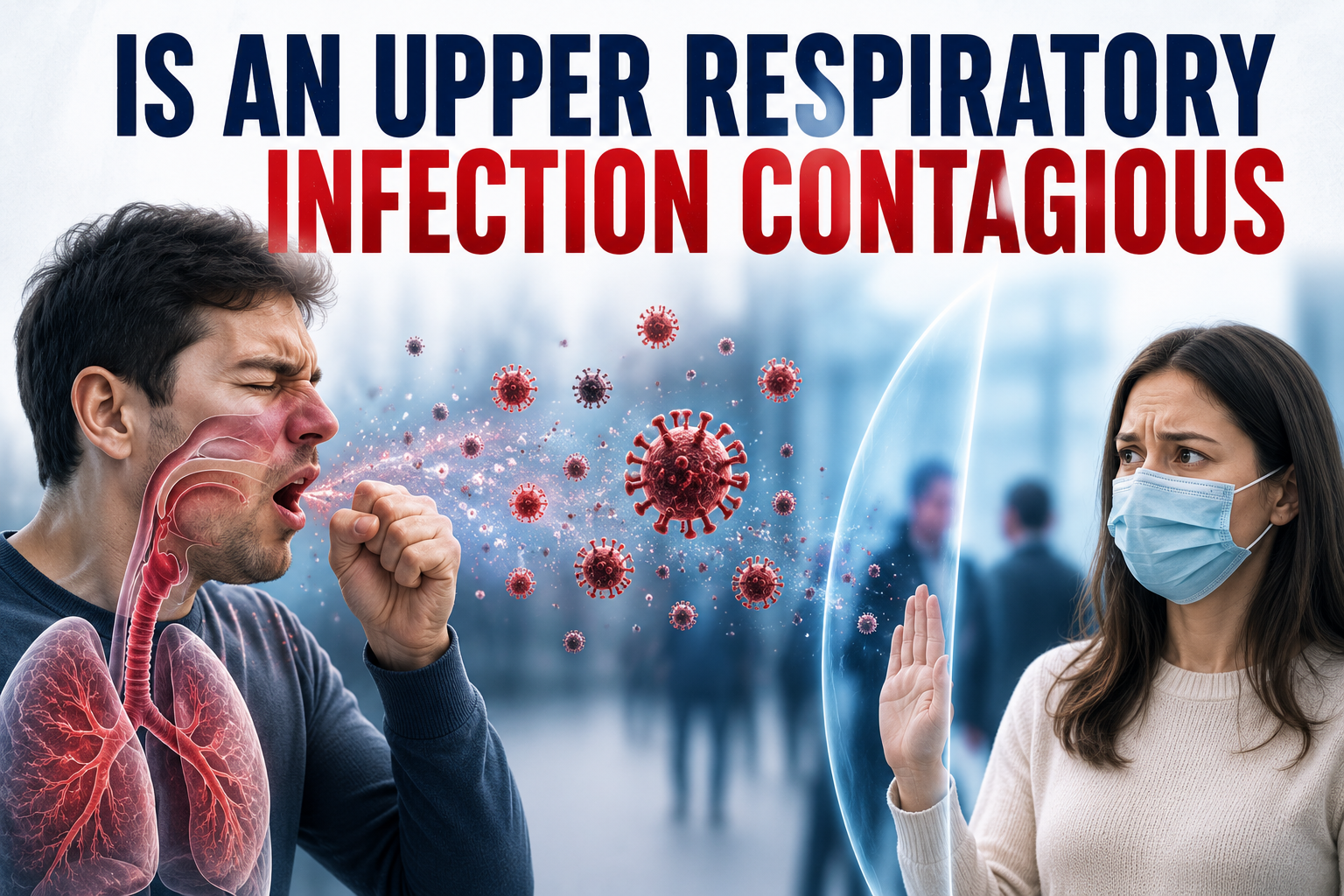
An upper respiratory infection is contagious — in most cases, highly so — and understanding exactly how and when it spreads can make the difference between protecting your household and unknowingly passing it to everyone around you.
If you’ve woken up with a scratchy throat, a runny nose, and the sinking feeling that you’re about to get sick, you’re not alone. Upper Respiratory Infections are among the most frequently diagnosed illnesses worldwide, yet most people are unsure when they became contagious or how long that window lasts.
This guide answers every critical question: how URIs transmit, when you’re most infectious, how long the contagious period runs, which populations face the highest risk, and the practical steps that actually reduce spread. Whether you’re trying to protect an infant at home or figure out when it’s safe to return to the office, you’ll find clear, evidence-based answers here.
What Is an Upper Respiratory Infection, and How Does URI Transmission Occur?
A URI — upper respiratory infection — is any infectious illness affecting the nasal passages, sinuses, pharynx, or larynx. The overwhelming majority are caused by viruses, most commonly rhinovirus, coronavirus (non-COVID strains), adenovirus, respiratory syncytial virus (RSV), and influenza. Bacterial URIs do occur but are far less common.
URI transmission route falls into three main categories, and knowing each one helps you understand exactly how to break the chain of spread:
• Respiratory droplets: When an infected person coughs, sneezes, or even talks forcefully, they release droplets carrying viral particles. These droplets typically travel up to 6 feet before settling.
• Direct contact: Touching an infected person and then touching your eyes, nose, or mouth. This is how many rhinovirus infections begin.
• Fomite transmission: Viruses can survive on hard surfaces — doorknobs, phones, keyboards — for several hours. According to the Centers for Disease Control and Prevention (CDC), rhinovirus can persist on surfaces for up to 3 hours.



Airborne transmission — where viral particles remain suspended in the air for extended periods — is possible with some respiratory viruses but plays a smaller role in typical URI spread compared to droplets and direct contact.
How Long Is a URI Contagious? The Contagious Period Explained
The contagious period for a Upper Respiratory Infection typically spans from one to two days before symptoms appear through approximately the first three to five days of active illness. For most healthy adults, peak contagiousness coincides with peak symptom severity — usually days two through four.
Pre-Symptomatic Contagiousness
This is the window that catches most people off guard. You can spread a URI before you feel sick. Viral shedding — the process by which your body releases virus particles — begins in the nasal passages about 24–48 hours before you notice a sore throat or congestion. This pre-symptomatic window is one reason URIs spread so efficiently in households, schools, and offices.
Duration by Virus Type
| Virus | Incubation Period | Contagious Period | Average Illness Duration |
| Rhinovirus | 1–3 days | 1–2 days before + 3–5 days after onset | 7–10 days |
| Adenovirus | 2–14 days | 2 days before + 5–10 days after onset | 5–10 days |
| RSV | 2–8 days | 1–2 days before + 3–8 days after onset | 1–2 weeks |
| Coronavirus (non-COVID) | 2–5 days | 1–2 days before + 3–5 days after onset | 7–14 days |
| Influenza | 1–4 days | 1 day before + 5–7 days after onset | 5–7 days |
Children and immunocompromised individuals may remain contagious for longer than the typical window. Pediatric studies have documented rhinovirus shedding for up to two weeks in young children, according to research published in the Journal of Clinical Virology.
How Upper Respiratory Infections Spread in Specific Settings
Understanding how URI spreads helps target prevention where it matters most. The risk is not uniform — it escalates sharply in crowded, enclosed environments with poor ventilation.
In the Household
Household transmission is the single most common route of URI spread. Shared bathroom surfaces, kitchen towels, and close sleeping quarters all facilitate fomite transmission.
Studies have shown that once one household member is infected with rhinovirus, the secondary attack rate — the probability of transmission to other members — ranges from 25% to 70%, depending on household size and hygiene practices.
In Schools and Childcare Settings
Children are both highly susceptible to Upper Respiratory Infections and the most prolific spreaders. A child with a URI sheds significantly higher viral loads than adults, and hand hygiene compliance in young children is notoriously low. According to the American Academy of Pediatrics (AAP), children average 6–8 URIs per year compared to 2–4 for adults.
In Workplaces and Public Spaces
Open-plan offices, public transport, and waiting rooms combine the three factors most favorable to URI transmission: proximity, enclosed air circulation, and surface contact. Studies show that influenza — a frequent URI cause during winter months — can spread across an entire office floor within a single workday when a symptomatic employee remains at their desk.
Who Is Most at Risk From URI Spread? Identifying High-Risk Populations
While a URI is usually mild in healthy adults, certain populations face a substantially elevated risk of complications — and of transmitting to others before they realize they are ill.
• Infants under 12 months: Their immune systems are still developing. RSV in this age group is a leading cause of hospitalization.
• Adults over 65: Immune senescence reduces their ability to clear viral infections quickly, extending both illness duration and contagiousness.
• Immunocompromised individuals: Those on chemotherapy, immunosuppressants, or living with HIV/AIDS can shed virus for weeks, not days.
• Pregnant women: URI complications including dehydration and fever in early pregnancy carry documented fetal risk.
• People with chronic lung disease: COPD and asthma patients are at high risk for URI-triggered exacerbations requiring emergency care.
URI Prevention Tips That Actually Work: Stopping the Spread
Most URI prevention advice is accurate but vague. Below are the specific, evidence-graded steps that clinical research consistently supports as most effective for reducing Upper Respiratory Infection transmission.
1. Wash hands with soap and water for at least 20 seconds — especially after blowing your nose, before meals, and after touching shared surfaces.
2. Avoid touching your face, particularly your eyes, nose, and mouth. This is the primary entry point for rhinovirus.
3. Disinfect high-contact surfaces daily using EPA-registered disinfectants when a household member is symptomatic.
4. Stay home during peak contagiousness — the first 3–5 days of symptoms — unless you have no alternative.
5. Use a tissue or your elbow (not your hand) when coughing or sneezing, and dispose of used tissues immediately.
6. Improve ventilation: open windows where feasible or use HEPA air purifiers in shared spaces.
When Is It Safe to Return to Work or School After a URI?
One of the most common questions surrounding URI contagiousness is when it is safe to re-enter public spaces. The answer depends on symptom trajectory, not just elapsed time.
General Return-to-Work Guidelines
• Fever-free for at least 24 hours without the use of fever-reducing medication (acetaminophen or ibuprofen).
• Symptoms visibly improving — not just plateaued but trending downward.
• Able to maintain adequate hydration and perform basic work tasks.
• No uncontrolled coughing or sneezing that would saturate a mask and risk widespread droplet exposure.
Exceptions and Special Circumstances
Healthcare workers, food handlers, and those working with immunocompromised individuals should follow stricter protocols — typically remaining home until fully asymptomatic, regardless of fever status. Many employer policies and state health department guidelines require this.
Real-World Scenario: How One URI Spreads Through a Household
Consider a two-parent household with two school-age children. Parent A begins experiencing mild nasal congestion on a Monday morning but attributes it to seasonal allergies. Over the next 48 hours, they continue normal activities — preparing family meals, sharing bathroom towels, and engaging in close conversation without masking.
By Wednesday, Parent A has a full URI with sore throat and low-grade fever. By Thursday, Child B develops symptoms, followed by Child C on Saturday. Parent B remains symptom-free but carries the virus by Sunday, confirmed when they test positive for rhinovirus. Total household transmission: 3 of 4 members infected within 9 days.
Can a URI Become Serious? Warning Signs That Require Medical Attention
Most URIs resolve on their own within 7–14 days. However, a small but significant percentage escalates to lower respiratory tract infections — bronchitis or pneumonia — particularly in high-risk populations.
Seek medical care if you or a family member experiences:
• Fever above 103°F (39.4°C) or fever that returns after improving
• Difficulty breathing or shortness of breath at rest
• Chest pain or persistent pressure
• Confusion or altered mental status
• Symptoms that worsen significantly after day 7 rather than improving
• Severe sore throat with difficulty swallowing (rule out strep throat or epiglottitis)
Bacterial superinfection — where a secondary bacterial infection follows an initial viral URI — is a documented complication. Sinusitis, otitis media, and streptococcal pharyngitis are the most common bacterial infections that can follow a viral URI.
FAQ
How long is a URI contagious?
Most URIs are contagious from 1–2 days before symptoms appear through approximately 3–5 days after onset. In children and immunocompromised individuals, the contagious period can extend up to 10–14 days. Peak contagiousness typically coincides with peak symptom severity.
Can you spread a URI before symptoms start?
Yes. Viral shedding — the release of infectious virus particles — begins in the nasal passages approximately 24–48 hours before noticeable symptoms appear. This pre-symptomatic window is one of the primary reasons URI spreads so quickly in households and workplaces.
Is a URI the same as a cold?
The common cold is technically a URI — specifically, a viral infection of the upper respiratory tract most often caused by rhinovirus. However, URI is a broader umbrella term that also includes sinusitis, pharyngitis (sore throat), laryngitis, and some cases of influenza affecting only upper airway structures.
How does a URI spread from person to person?
URI spreads primarily through respiratory droplets released during coughing, sneezing, or close conversation. It also spreads through direct contact — touching an infected person and then touching your face — and via contaminated surfaces (fomite transmission). Rhinovirus can survive on hard surfaces for up to 3 hours.
When can I go back to work with a URI?
Most infection control guidelines recommend returning to work when you have been fever-free for at least 24 hours without medication and your symptoms are visibly improving. Healthcare workers and food handlers typically must be fully asymptomatic before returning, per employer and regulatory guidelines.
Can a URI turn into pneumonia?
In most healthy adults, a URI remains confined to the upper airway. However, in children under 5, adults over 65, and immunocompromised individuals, a viral URI can progress to viral pneumonia or trigger a secondary bacterial pneumonia. Worsening shortness of breath and persistent fever after day 7 are warning signs.
What is the fastest way to recover from a URI?
No antiviral medication exists for most URI-causing viruses. Recovery is supported by adequate rest, staying hydrated, using saline nasal rinses, and taking OTC medications for symptom relief. Zinc lozenges started within 24 hours of symptom onset have modest evidence for shortening URI duration, according to a Cochrane Review.
Conclusion
An upper respiratory infection is contagious — and it can begin spreading before you feel a single symptom. Understanding the contagious window, the primary transmission routes, and the specific behaviors that accelerate spread empowers you to make smarter decisions about when to stay home, how to protect vulnerable family members, and when it is genuinely safe to return to normal activities.
Whether your concern is protecting an infant, managing a URI safely in a workplace, or simply recovering faster, the evidence is clear: hand hygiene, early isolation during peak contagiousness, and awareness of pre-symptomatic spread are your most powerful tools.
Related Posts
Does Facial Work for Acne? Benefits, Risks, Types, and What to Expect
Chelsea Crumpler UNC Health: Career, HR Leadership, and Professional Contributions
Can I Workout With Stitches on My Head? Complete Guide
How Long Does a Fractured Toe Take to Heal? (And What Affects Your Recovery)