Yes, CPR does break ribs in a large share of cases, and that is a normal, expected part of effective chest compressions rather than a sign something went wrong. If you have ever performed CPR, watched someone else do it, or worried about hurting a family member during an emergency, that cracking sensation under your hands can feel alarming. You may be wondering whether you did something incorrectly or whether the injury could have been avoided.
This guide walks through what the research actually shows about rib fractures during CPR, why they happen, who is most at risk, and why medical professionals agree you should never stop compressions out of fear of causing them.
| Key Takeaways• Rib fractures are the most common CPR-related injury, with a pooled prevalence of roughly 55% across 74 studies covering over 16,000 patients.• Individual studies report rates ranging from about 26% to 80%, and some autopsy-based research puts the figure as high as 97%.• Rib fractures happen because effective compressions require pressing hard and fast enough to circulate blood, which stresses the rib cage.• Older adults and people with osteoporosis fracture ribs more easily than younger, healthier patients.• Medical guidance is consistent: the risk of a rib fracture is far less serious than the risk of death from stopping compressions.• Mechanical CPR devices are associated with a higher injury risk than manual compressions, according to meta-analysis data. |
Why Does CPR Break Ribs in the First Place?
Chest compressions work by physically squeezing the heart between the sternum and spine to push blood through the body. To do that, the American Heart Association recommends pressing down at least 2 inches on an adult chest, at a rate of 100 to 120 compressions per minute.
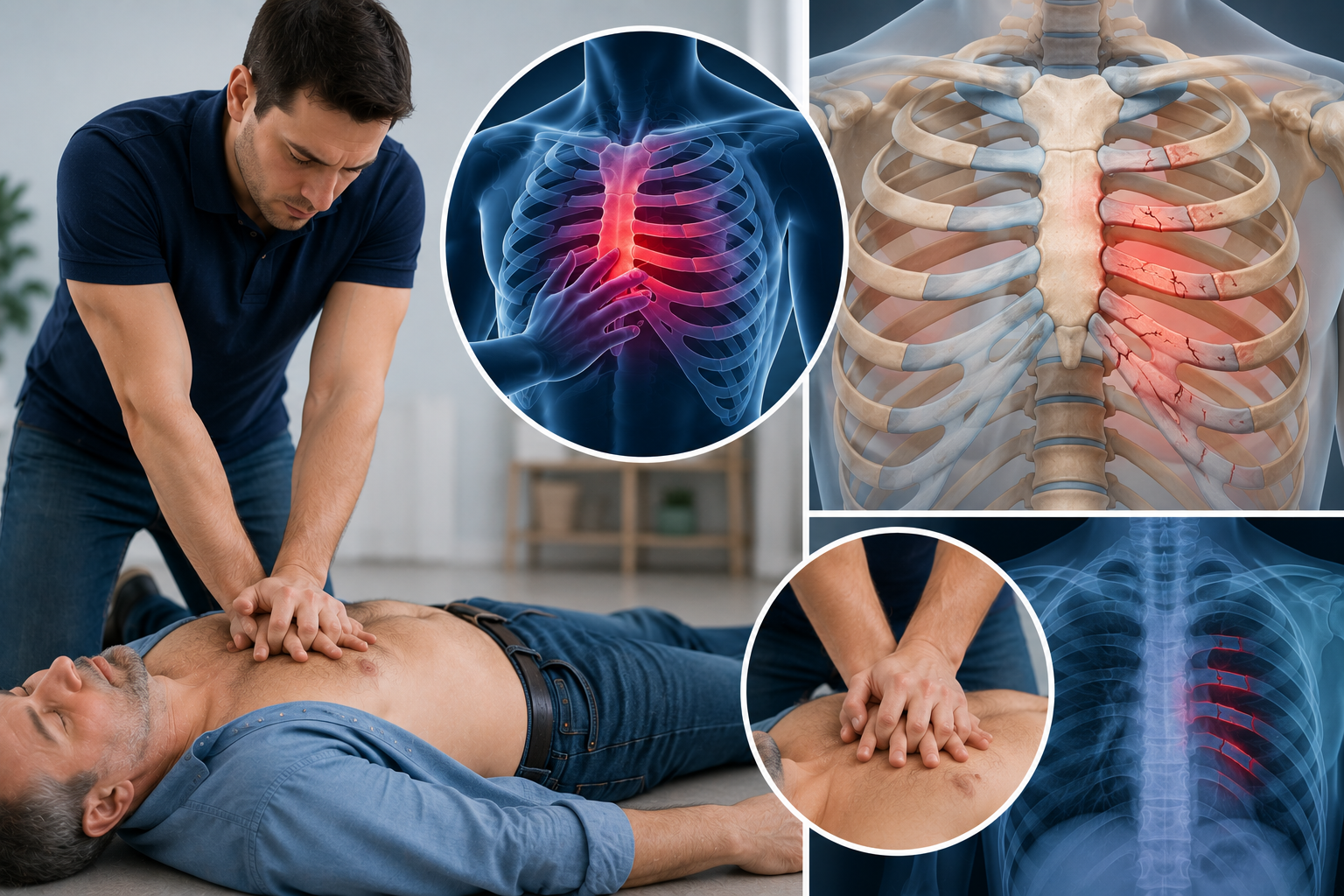
That depth and speed put real mechanical stress on the rib cage. Ribs can fracture in two ways during compressions:
• Direct fractures: caused by force applied straight onto the sternum and the ribs nearest it.
• Indirect fractures: caused by the rib cage bending and flexing as the chest is repeatedly compressed and released.
Research using CT imaging has found that most fractures cluster anterolaterally, between the third and sixth ribs on both sides of the chest, which lines up with where hands are placed during compressions.
How Common Are Rib Fractures From CPR?
Rib fractures are not a rare complication of CPR. According to a 2023 systematic review and meta-analysis published in the European Journal of Trauma and Emergency Surgery, researchers pooled data from 74 studies covering 16,629 patients and found that any CPR-related injury occurred in about 60% of cases, with rib fractures alone showing a pooled prevalence of 55%.



Individual studies show a wide range depending on how injuries were detected. Clinical or CT-based studies commonly report rib fractures in 26% to 80% of patients, while autopsy-based research, which detects even hairline fractures missed on X-ray, has reported rates as high as 97%.
| Pro TipIf you performed CPR and the person survived with cracked or broken ribs, that outcome is expected and documented in medical literature — not evidence of improper technique. Rib pain is treatable; cardiac arrest without CPR is usually fatal. |
A separate imaging study of 40 patients who received CT scans after CPR documented 423 total rib fractures, reinforcing that multiple fractures, not just one, are the norm rather than the exception.
Manual CPR vs. Mechanical CPR: Injury Risk Compared
Mechanical chest compression devices are sometimes used by EMS crews for consistent depth and rate. However, they carry a higher documented injury risk than manual compressions performed by a trained rescuer or bystander.
| Factor | Manual CPR | Mechanical CPR |
| Relative injury risk | Baseline | 36% higher risk ratio (1.36) vs. manual |
| Who typically performs it | Bystanders, nurses, EMTs, physicians | EMS or hospital staff using a device |
| Consistency of depth/rate | Varies with rescuer fatigue | Mechanically consistent |
| Best-known use case | First response, bystander CPR | Prolonged resuscitation, transport |
Who Is Most at Risk of Rib Fractures During CPR?
Rib fractures can happen to almost anyone receiving chest compressions, but certain factors increase the likelihood and severity.
• Older adults: Bones naturally lose density with age, and studies on CPR-related injuries skew toward older patient populations.
• People with osteoporosis: Reduced bone mineral density makes ribs more brittle and prone to fracture under compression force.
• Thin or frail patients: Less soft tissue and muscle over the rib cage means force transfers more directly to bone.
• Patients receiving mechanical CPR: As shown above, device-assisted compressions carry a higher injury risk than manual CPR.
• Patients requiring prolonged resuscitation: More compression cycles mean more cumulative stress on the rib cage.
| Hypothetical Example (for illustration purposes):Consider a 78-year-old woman with known osteoporosis who collapses at home. Her husband begins hands-only CPR immediately and continues until paramedics arrive eight minutes later. She survives, but imaging at the hospital later shows five fractured ribs. Her care team explains this is a common and expected outcome of effective compressions in an older patient with lower bone density, and that her survival was directly tied to CPR starting immediately.Note: This scenario is illustrative. Actual outcomes vary by age, bone health, compression technique, and time to treatment. |
Should You Stop CPR If You Feel or Hear Ribs Break?
No. Every major resuscitation body, including the American Heart Association and the American Red Cross, instructs rescuers to continue compressions even if they feel or hear a rib crack. Stopping compressions cuts off blood flow to the brain and heart, and every pause reduces the person’s chance of survival.
The person in cardiac arrest is unconscious during CPR and does not feel pain from the fracture in the moment. Any discomfort is addressed later, during recovery, once circulation and breathing have been restored.
| WarningNever withhold or interrupt CPR because you are afraid of breaking ribs. Cardiac arrest without immediate CPR is fatal in the vast majority of cases, while a rib fracture is a treatable, non-life-threatening injury. |
Signs a CPR Survivor May Have Broken Ribs
Family members and caregivers often want to know what to watch for after a loved one has been resuscitated. Common signs of rib fractures following CPR include:
• Sharp or aching chest pain, especially with deep breaths, coughing, or movement.
• Visible bruising or swelling across the chest and sternum.
• Tenderness when the chest wall is touched near the compression site.
• Shallow breathing due to pain, which can raise the risk of pneumonia if not managed.
• A clicking or grinding sensation in more severe multi-rib fractures.
Hospitals typically confirm rib fractures with a CT scan, since standard X-rays can miss hairline or non-displaced fractures that CT imaging detects more reliably.
Possible Complications From CPR-Related Rib Fractures
Most rib fractures from CPR heal on their own with pain management and rest, but multiple fractures can occasionally lead to complications that need monitoring.
| Complication | What It Means |
| Pneumonia | Shallow breathing from rib pain can allow fluid to build up in the lungs; one study found pneumonia in 74% of patients who needed surgical rib fixation. |
| Flail chest | Multiple adjacent rib fractures can create a segment that moves independently, impairing normal breathing. |
| Pneumothorax | A fractured rib can occasionally puncture the lung lining, causing partial lung collapse. |
| Chronic pain | Some patients report lingering discomfort for weeks during the healing process. |
Surgical rib fixation is uncommon and generally reserved for patients who cannot be weaned off a ventilator because of severe, multiple fractures. For most CPR survivors, recovery involves pain control, breathing exercises, and follow-up imaging rather than surgery.
Can You Reduce Rib Fracture Risk Without Reducing CPR Effectiveness?
Proper hand placement and technique can help limit unnecessary injury, though some degree of rib stress is an unavoidable part of effective compressions.
1. Place the heel of your hand on the center of the chest, on the lower half of the sternum, not on the ribs directly.
2. Interlace your fingers and keep them off the rib cage to focus force on the sternum.
3. Compress straight down, avoiding rocking or angled pressure that twists the rib cage.
4. Allow full chest recoil between compressions so the chest wall isn’t held under constant pressure.
5. Maintain the recommended depth and rate rather than compressing harder than necessary.
These steps support proper technique, but they will not eliminate the chance of a fracture in an older or frailer patient. That trade-off is accepted in resuscitation science because effective compressions save lives.
Frequently Asked Questions
Q: Is it normal to feel a rib crack during CPR?
Yes. Rescuers frequently feel or hear a pop or crack during compressions. This is a known, documented part of performing effective CPR and is not a sign of doing it wrong.
Q: Can broken ribs from CPR be fatal?
Rib fractures themselves are rarely fatal. In rare cases, multiple fractures can cause complications like a punctured lung, but these are treatable and far less dangerous than untreated cardiac arrest.
Q: Should I do CPR softer to avoid breaking ribs?
No. The American Heart Association recommends compressing at least 2 inches deep on an adult chest. Compressing too gently reduces blood flow and lowers the person’s chance of survival.
Q: How long does it take to recover from CPR-related rib fractures?
Most uncomplicated rib fractures heal within 6 to 8 weeks with rest, pain management, and breathing exercises, similar to rib fractures from other causes.
Q: Do children’s ribs break during CPR as often as adults’?
Children’s ribs are more flexible than adult ribs, so fractures are less commonly reported in pediatric CPR, though injuries can still occur, particularly in infants.
Q: What’s the difference between rib fractures from manual CPR versus a mechanical device?
Meta-analysis data shows mechanical CPR devices carry a 36% higher relative risk of injury, including rib fractures, compared to manual compressions performed by a rescuer.
Q: Will I get in trouble for breaking someone’s ribs during CPR?
No. Good Samaritan laws in most regions protect bystanders who provide reasonable emergency assistance, and rib fractures from properly performed CPR are a recognized, accepted risk of lifesaving care.
The Bottom Line
Rib fractures are one of the most common, well-documented side effects of effective CPR, affecting roughly half of patients across major studies. They happen because the depth and force needed to keep blood flowing during cardiac arrest inevitably stresses the rib cage, especially in older adults.
The most important takeaway is simple: never stop or soften compressions out of fear of causing a fracture. A broken rib heals; a brain and heart deprived of oxygen for too long often cannot recover.
RELATED ARTICLES
Urgent Care for Kidney Stones: When It’s the Right Call
Endometriosis Flare Up Symptoms: What They Feel Like and How to Cope
How Long After a Dentist Cleaning Can I Eat? Complete Guide