

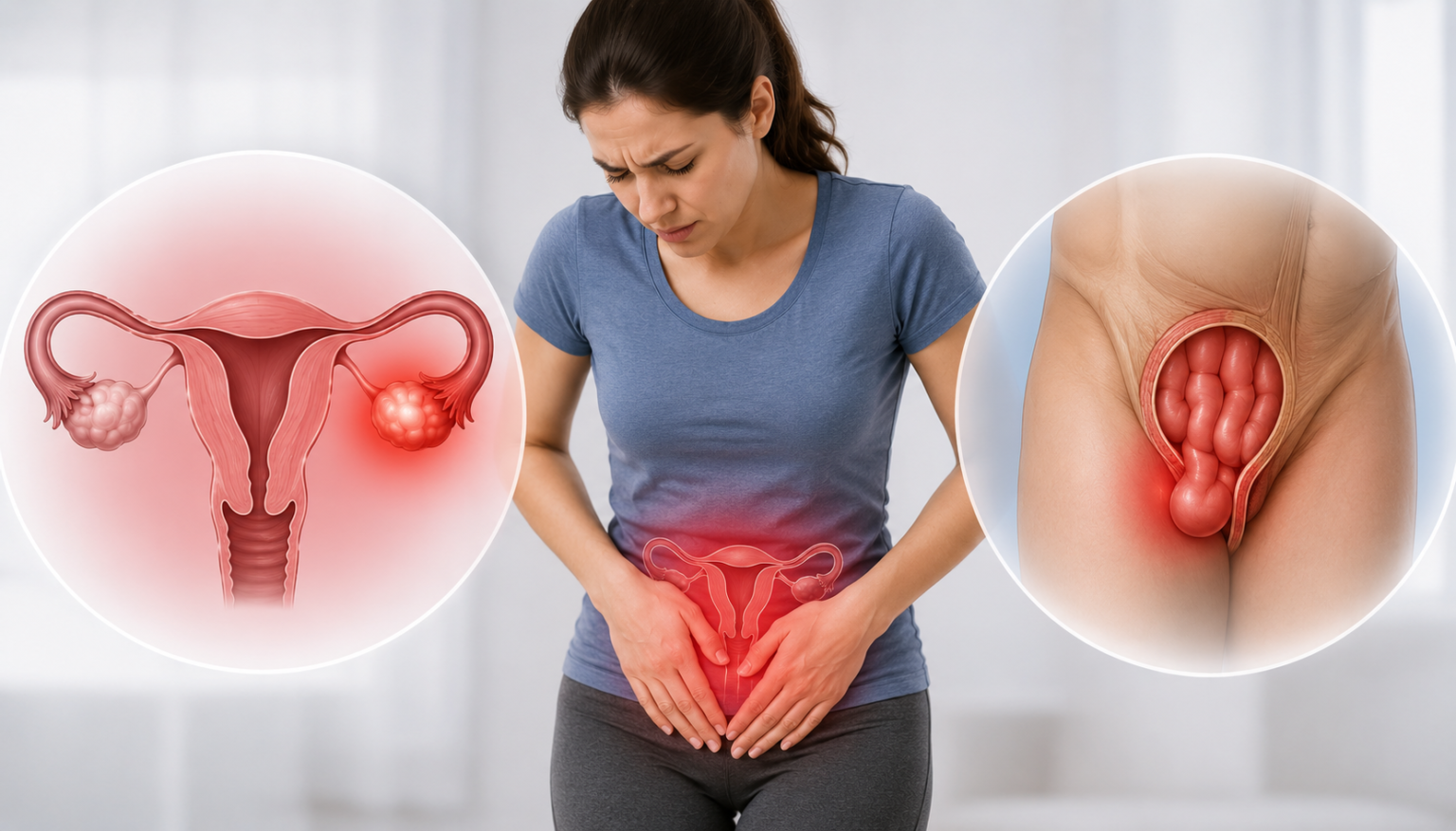
Many women feel a strange ache low in the belly and immediately worry about their ovaries, without realizing a hernia can cause almost the same discomfort. Learning how to know if i have ovary pain vs hernia starts with paying close attention to where the pain sits, when it shows up, and what makes it worse.
Ovary pain usually stays connected to the menstrual cycle and hormonal changes, while hernia pain is tied to physical strain, movement, or a visible bulge under the skin. Both conditions can feel like a dull ache one day and a sharp pinch the next, which is exactly why so many people confuse them.
This article breaks down every difference in plain, simple language so you can understand your body better before deciding whether to book a gynecologist or a general surgeon.
Key Takeaways
- Ovary pain is usually linked to the menstrual cycle, while hernia pain is linked to physical strain and movement.
- A hernia often shows a visible or touchable bulge; ovary pain almost never does.
- Coughing, lifting, or standing for long periods tends to worsen hernia pain specifically.
- Sudden, severe pain with fever, vomiting, or a hard lump needs emergency medical attention.
- A doctor confirms the exact cause through a physical exam and imaging such as an ultrasound.
What Is Ovary Pain?
Ovary pain comes from the reproductive organs and is closely tied to the natural rhythm of the menstrual cycle. It can feel like a dull cramp, a sharp twinge, or a heavy pressure low in the pelvis, and it often shifts depending on which ovary is active that month.
Common Causes
Ovary pain most often comes from ovulation, when an egg is released and causes brief, mid-cycle discomfort known as mittelschmerz. Ovarian cysts are another frequent cause, especially when a fluid-filled sac grows large enough to press on nearby tissue. Conditions such as polycystic ovary syndrome (PCOS) and endometriosis can also create ongoing pelvic pain that flares around certain points in the cycle.
Where Ovary Pain Is Usually Felt
This type of pain sits deep in the lower pelvis, typically on one side, just above the hip bone and below the belly button. It rarely spreads toward the groin crease or upper thigh the way hernia pain does. Some women also notice it radiating slightly toward the lower back during heavier flare-ups.
How Ovary Pain Feels
Most people describe ovary pain as a dull ache or cramping sensation that builds gradually rather than appearing suddenly. It can also turn into a sharp, stabbing pain during ovulation or if a cyst ruptures. The intensity usually rises and falls with the menstrual cycle instead of staying constant throughout the day.
What Is a Hernia?
A hernia develops when an internal tissue or organ pushes through a weak spot in the surrounding muscle wall. Unlike ovary pain, it has nothing to do with hormones and everything to do with physical pressure and muscle strength.
Types of Hernias
Inguinal hernias are the most common type and occur in the groin area, sometimes confused with pelvic or ovarian discomfort. Femoral hernias sit slightly lower, near the top of the thigh, and are more frequently seen in women. Umbilical hernias appear around the belly button and can also cause lower abdominal discomfort that feels similar to ovary-related pain.
Where Hernia Pain Is Usually Felt
Hernia pain concentrates in the groin, lower abdomen, or near the belly button, depending on the type. It often comes with a noticeable bulge that you can see or feel with your hand, especially when standing upright. The discomfort tends to stay in one fixed spot rather than shifting from side to side like ovary pain.
How Hernia Pain Feels
Many people describe hernia pain as a heavy, pulling, or dragging sensation rather than a cramp. It usually worsens with physical activity, lifting heavy objects, or straining during a bowel movement. Resting or lying down often brings quick relief, which is a pattern rarely seen with ovary pain.
Key Differences Between Ovary Pain and Hernia
Once you understand the individual traits of each condition, spotting the difference becomes much easier. The clearest clues involve pain location, its relationship to your cycle, how movement affects it, and whether a physical bulge is present.
Location and Positioning of Pain
Ovary pain typically stays in the pelvis, above the hip bone and below the navel, while hernia pain sits closer to the groin crease or belly button. If the discomfort moves toward the upper thigh or feels connected to a specific spot you can press on, a hernia is more likely. Pain that feels deep and internal, without a fixed external point, leans more toward the ovaries.
Link to Menstrual Cycle
Ovary pain almost always follows a pattern connected to your period, ovulation, or hormonal shifts across the month. Hernia pain has no relationship to the menstrual cycle whatsoever and stays consistent regardless of what week you’re in. Tracking your symptoms against your cycle for a month or two often reveals the true source quickly.
Effect of Movement, Coughing, or Straining
A hernia reacts strongly to physical exertion, becoming noticeably worse when you cough, sneeze, lift something heavy, or stand for a long stretch. Ovary pain generally does not change much with these actions, since it originates internally rather than from a muscle wall weakness. If straining consistently triggers or worsens your pain, a hernia becomes the more likely explanation.
Presence of a Visible Bulge
A hernia frequently produces a bulge you can see or feel, which may grow larger when standing and shrink or disappear when lying flat. Ovary pain never produces an external bulge, since the ovaries sit deep within the pelvis and are not visible or palpable through the abdominal wall. Checking for a lump while standing versus lying down is one of the simplest self-checks available.
Comparison Table — Ovary Pain vs Hernia
| Symptom | Ovary Pain | Hernia |
| Pain location | Lower pelvis, one side | Groin, lower abdomen, or navel |
| Linked to menstrual cycle | Yes, closely tied | No connection |
| Visible or touchable bulge | Never present | Often present, especially standing |
| Worsens with coughing/lifting | Rarely affected | Frequently worsens |
| Relief when lying down | Little to no change | Often improves or bulge reduces |
| Common triggers | Ovulation, cysts, PCOS | Heavy lifting, straining, muscle weakness |
Symptoms That Need Immediate Medical Attention
Some symptoms from either condition signal a medical emergency rather than everyday discomfort, and recognizing them quickly can prevent serious complications.
Warning Signs of Ovarian Cyst Rupture or Torsion
Sudden, severe pelvic pain on one side, especially paired with dizziness, fainting, or heavy vaginal bleeding, may point to a ruptured cyst or ovarian torsion. Nausea and vomiting that appear alongside sharp pelvic pain also raise concern for a twisted ovary, which cuts off blood supply and requires urgent surgery. Waiting too long with these symptoms can risk permanent damage to the ovary.
Warning Signs of a Strangulated Hernia
A hernia bulge that turns red, purple, or extremely tender, especially if it will not push back in, may indicate strangulation, where blood supply to the trapped tissue is cut off. This is often paired with nausea, vomiting, and a rapidly worsening, constant pain rather than the usual activity-related discomfort. A strangulated hernia is a surgical emergency and should never be left untreated.
How Do Doctors Diagnose the Difference?
Self-checking symptoms at home is useful, but a proper diagnosis always requires a professional evaluation to confirm the exact cause.
Physical Examination
A doctor will typically press gently on the abdomen and groin while you stand, cough, and lie down to check for a bulge that shifts with position. For suspected ovary issues, a pelvic exam helps assess tenderness, swelling, or abnormal masses near the reproductive organs. This hands-on step often narrows down the likely cause before any imaging is even ordered.
Imaging Tests
An ultrasound is the most common tool used to examine the ovaries for cysts, torsion, or other abnormalities causing pain. For hernias, doctors may use ultrasound as well, though a CT scan is sometimes needed to get a clearer picture of tissue pushing through the abdominal wall. These tests give a definitive answer when the physical exam alone is not conclusive.
When to See a Gynecologist vs a General Surgeon
If your pain closely follows your menstrual cycle and has no visible bulge, a gynecologist is the right specialist to consult first. If you notice a lump that changes with standing or straining, a general surgeon who handles hernia repair is the better starting point. When you are unsure which applies, a primary care doctor can examine you first and refer you to the correct specialist.
Treatment Approaches
Treatment paths for these two conditions are completely different, which makes an accurate diagnosis essential before starting any plan.
Managing Ovary-Related Pain
Mild ovary pain from ovulation or small cysts often resolves on its own with rest, heat therapy, and over-the-counter pain relief. Hormonal birth control may be recommended to regulate cycles and reduce recurring cyst formation in some cases. Larger cysts, persistent pain, or suspected torsion typically require closer monitoring or surgical intervention.
Managing a Hernia
Small, mild hernias that cause little discomfort may only need monitoring and lifestyle adjustments such as avoiding heavy lifting. Larger or symptomatic hernias usually require surgical repair, since they do not resolve on their own and can worsen over time. Surgery is generally straightforward, and most people recover within a few weeks with proper aftercare.
Frequently Asked Questions
Can a hernia be mistaken for ovarian pain?
Yes, especially inguinal or femoral hernias, since both can cause lower abdominal or groin discomfort. The main clue is a visible bulge or a link to physical strain, which points toward a hernia rather than the ovaries.
Can you have both a hernia and ovary pain at the same time?
It is possible, since the two conditions are unrelated and can occur together by coincidence. If your pain has mixed features, a full medical exam is the safest way to sort out both causes.
Does hernia pain get worse around your period?
No, hernia pain stays consistent regardless of your menstrual cycle. If your pain clearly worsens only around certain days of the month, ovary-related causes are more likely.
When does ovary pain become an emergency?
Sudden, severe pain with fainting, heavy bleeding, or persistent vomiting should be treated as an emergency. These symptoms can indicate a ruptured cyst or ovarian torsion, both of which need prompt medical care.
Conclusion
Telling ovary pain apart from a hernia comes down to a few clear signals: cycle-related timing, pain location, response to movement, and whether a bulge is present.
Ovary pain stays internal and follows your monthly hormonal rhythm, while a hernia reacts to physical strain and often shows itself as a visible lump. If symptoms are severe, sudden, or paired with fever or vomiting, seek medical care right away rather than guessing at home.
RELATED POSTS
How to Cure Gum Disease Without a Dentist: Natural Ways to Heal Gums at Home
How to Stop Gum Bleeding Immediately: 9 Fast, Safe Fixes
How to Sleep with a Pinched Nerve in a Shoulder Blade?
Heart Home Health Care: Complete Guide to Services, Care Process, and Benefits