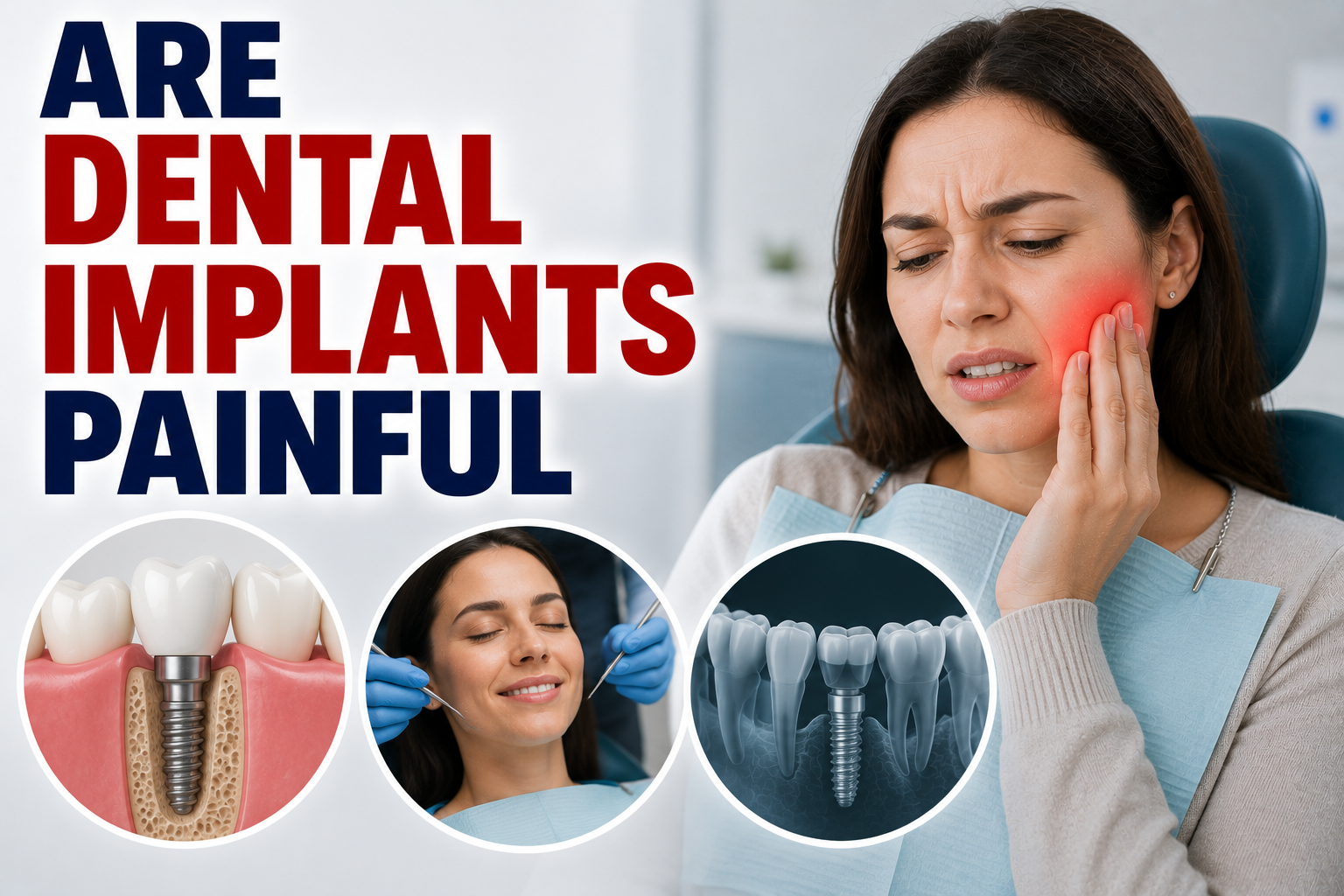
Are dental implants painful — that’s the first question almost every patient asks before booking a consultation. The fear of a drill near the jawbone keeps many people stuck with a gap in their smile for years longer than necessary. The honest answer is more reassuring than most patients expect, and this guide breaks down exactly what you’ll feel during surgery, in the days after, and when pain signals a real problem.
You’ll get a day-by-day recovery timeline, a direct comparison to tooth extraction, and practical relief strategies dentists actually recommend.
Key Takeaways
- Most patients feel no sharp pain during placement because the site is fully numbed with local anesthesia.
- Peak discomfort typically occurs around 24 hours after surgery and steadily declines from there.
- Research comparing procedures found implant placement is often less painful than a tooth extraction.
- Pain usually fades to mild tenderness within 3 to 7 days for a single, straightforward implant.
- Sharp, worsening, or throbbing pain after day 3 to 5 is not typical and should prompt a call to your dentist.
- Sedation options exist for anxious patients, even though most implants only require local anesthesia.
Is Getting a Dental Implant Painful? What to Really Expect
The surgery itself is not painful in the way people imagine. Your dentist numbs the jaw and gum tissue with local anesthesia before making any incision, so you should feel pressure and vibration rather than pain during the procedure. Most patients describe the sensation as similar to a routine tooth extraction, not a dramatic surgical event.
A clinical study tracking 510 implants placed in 234 patients recorded mean pain scores on a 0–10 scale at several points after surgery. Pain peaked at 24 hours post-surgery with a mean score of just 2.01, then decreased steadily over the following weeks (Source: PubMed, Assessment of Pain Associated With the Surgical Placement of Dental Implants).
Pro Tip: Ask your dentist about a pre-emptive analgesic — taking an anti-inflammatory before the numbness wears off can blunt the pain spike that typically hits within the first day.
- Numbness during the procedure means you shouldn’t feel cutting or drilling.
- Pressure and vibration are normal and expected sensations.
- Mild soreness usually begins as anesthesia wears off, several hours later.
Dental Implant Pain Timeline: Day by Day Recovery
Understanding the dental implant recovery timeline helps you separate normal healing from a genuine complication. Discomfort follows a predictable arc for most patients, especially with a single implant and healthy bone.
| Recovery Stage | What You’ll Likely Feel |
| During surgery | Numb; pressure or vibration only, no pain |
| 0–4 hours after | Mild ache as anesthesia fades |
| 24 hours after | Peak soreness and swelling (average score around 2/10) |
| 2–3 days after | Swelling begins to subside; soreness eases |
| 4–7 days after | Mild tenderness with chewing; near-normal function |
| 1–2 weeks after | Minimal to no discomfort for most patients |
Warning: Every patient heals differently. Multiple implants, bone grafting, or sinus lift procedures typically extend this timeline and increase soreness compared to a single, straightforward implant.



What Causes Pain After a Dental Implant?
Post-surgical discomfort isn’t random — it’s tied to specific, measurable factors. Knowing what drives implant pain relief needs can help you and your dentist plan ahead.
A study of 137 implant patients found that pain intensity at 24 hours was significantly worse than immediately after surgery or at 72 hours, and that surgery duration and whether patients used analgesics afterward were independent predictors of pain severity (Source: PMC, Investigation and Analysis of Pain After Dental Implantation and Its Influencing Factors). Separately, researchers found operator experience and pain experienced during surgery itself were strongly linked to higher pain scores the next day (Source: PubMed, Assessment of Pain Associated With the Surgical Placement of Dental Implants).
- Surgery length — longer procedures tend to produce more post-op soreness.
- Number of implants placed — multiple sites mean more tissue trauma to heal.
- Post-op medication use — skipping recommended pain relief early on correlates with worse pain later.
- Surgeon experience — more experienced operators were linked to lower next-day pain scores in published research.
Dental Implants vs. Tooth Extraction: Which Hurts More?
This is one of the most common comparisons patients search for, and the research is reassuring. A comparative study evaluating pain in patients undergoing tooth extraction versus implant placement found that extraction patients often reported higher pain scores than implant patients at multiple points during recovery (Source: PMC, A Comparative Study of Pain in Patients Planned for Tooth Extraction and Dental Implant Insertion).
| Factor | Tooth Extraction | Dental Implant Placement |
| Procedure type | Removes existing tooth | Places a titanium post in bone |
| Reported pain (research-based) | Often rated higher | Often rated lower |
| Swelling | Common | Common but often milder |
| Recovery to normal function | Days to 1–2 weeks | Days to 1–2 weeks |
Hypothetical Example (for illustration purposes): A 42-year-old patient needing both an extraction on one side and an implant placed on the other side of the mouth in separate visits reported the extraction site felt more tender the first two days, while the implant site was manageable with over-the-counter pain relief alone. Note: This scenario is illustrative. Actual results vary by patient, procedure complexity, and individual pain tolerance.
How to Manage Dental Implant Pain at Home
Effective aftercare shortens how long soreness lingers and lowers your risk of complications. Simple, consistent steps make the biggest difference in the first 72 hours.
- Take prescribed or recommended anti-inflammatory medication on schedule, not just when pain spikes.
- Apply a cold compress in 15–20 minute intervals during the first 24 hours to limit swelling.
- Stick to soft foods — yogurt, mashed potatoes, smoothies — for the first few days.
- Avoid smoking and alcohol, both of which slow healing and can worsen discomfort.
- Rinse gently with warm salt water starting 24 hours after surgery, avoiding vigorous swishing.
A systematic review of analgesic use after dental implant surgery found that administering pain medication proactively — rather than waiting for pain to start — may offer real advantages in managing post-operative discomfort, though researchers noted more high-quality studies are still needed to define an optimal protocol (Source: PMC, Analgesics for Dental Implants: A Systematic Review).
Anesthesia and Sedation Options for a Pain-Free Procedure
Most single-implant procedures only require local anesthesia, the same numbing injection used for fillings. But sedation for dental implants is available for patients with dental anxiety, complex cases, or multiple implants placed in one visit.
Local Anesthesia
Numbs only the surgical site. You’re fully awake and aware, but you shouldn’t feel pain — only pressure.
Nitrous Oxide (Laughing Gas)
A mild sedative inhaled through a mask. It reduces anxiety while keeping you conscious and able to respond, and it wears off quickly after the mask is removed.
Oral or IV Sedation
Used for anxious patients or longer procedures like full-arch implants. You remain semi-aware but relaxed, and many patients recall little to nothing of the procedure afterward.
Research on dental anxiety and implant pain found that patients with higher baseline dental anxiety often reported measurable improvements in both anxiety and pain scores by one week post-surgery, regardless of overall health status (Source: PMC, Changes of Dental Implant Surgery-Related Anxiety and Pain With Respect to ASA-Physical Status).
When Dental Implant Pain Is Not Normal — Warning Signs
Mild soreness that improves daily is expected. Pain that worsens, spreads, or returns after initially fading is not, and it deserves a prompt call to your dentist.
Warning: Contact your dentist immediately if you notice any of the following after day 3–5 of recovery.
- Throbbing pain that intensifies instead of easing
- Pain radiating to your ear, eye, or jaw joint
- Persistent numbness beyond 24–48 hours in areas that should have regained feeling
- Visible pus, foul taste, or a fever alongside implant-site pain
- Fever or facial swelling that continues to grow past the second day
A case report published in the Journal of the American Dental Association documented a patient who developed persistent facial pain, rated 8 out of 10, weeks after implant placement — a rare but real complication underscoring why unusual or escalating pain always warrants professional evaluation rather than home management (Source: JADA, Prevention and Management of Persistent Idiopathic Facial Pain After Dental Implant Placement).
How to Choose an Experienced Implant Dentist to Minimize Pain
The dentist placing your implant meaningfully affects how much discomfort you feel afterward. Published research linked operator experience to next-day pain outcomes, making this one of the few pain factors you can actually control before surgery even starts.
- Ask how many implants the dentist places per year, not just per career.
- Confirm they use 3D imaging (CBCT) for precise, guided placement.
- Ask about their post-op pain management protocol before you commit to surgery.
- Read verified patient reviews focused specifically on recovery experience, not just results.
Frequently Asked Questions
How painful is a dental implant on a scale of 1 to 10?
Research tracking hundreds of implant patients found average pain scores around 2 out of 10 at their peak, roughly 24 hours after surgery, then declining steadily from there.
Is getting a dental implant more painful than a tooth extraction?
Comparative research found implant patients often reported lower pain scores than extraction patients at multiple recovery points, though individual experiences vary.
How long does dental implant pain last?
For a single, straightforward implant, noticeable soreness typically fades within 3 to 7 days, with only mild tenderness lingering during chewing.
Do they put you to sleep for dental implants?
Not usually. Most implants use only local anesthesia. Sedation or IV options exist for anxious patients or complex, multi-implant cases.
What is the most painful part of getting a dental implant?
The 24-hour mark after surgery, once anesthesia has fully worn off, is typically when soreness and swelling peak before gradually improving.
Can you eat normally after a dental implant?
Not immediately. Stick to soft foods for the first few days, then gradually reintroduce firmer foods as tenderness subsides, usually within one to two weeks.
How do you know if a dental implant is failing or infected?
Warning signs include worsening pain, visible pus, persistent swelling, fever, or pain that returns after initially improving. Any of these calls for prompt dental evaluation.
Final Thoughts
Are dental implants painful? For most patients, the honest answer is: far less than expected, and less than many alternatives like extraction.
Numbing keeps the procedure itself pain-free, mild soreness peaks around 24 hours, and most people feel back to normal within a week.
If you’ve been putting off treatment out of fear, this is usually the wrong reason to wait.
Related Posts
Growing Pains Massage: Safe Techniques and Natural Ways to Relieve Leg Pain in Children
How to Cure Gum Disease Without a Dentist: Natural Ways to Heal Gums at Home
Ear Piercing Pain Scale: A Complete Guide to Pain Levels for Every Piercing
Lower Back Pain and Heart Attacks: Signs, Symptoms, Causes, and When to Seek Help
ESG Regulations Food Sector: Complete Guide to Compliance, Sustainability, and Reporting