

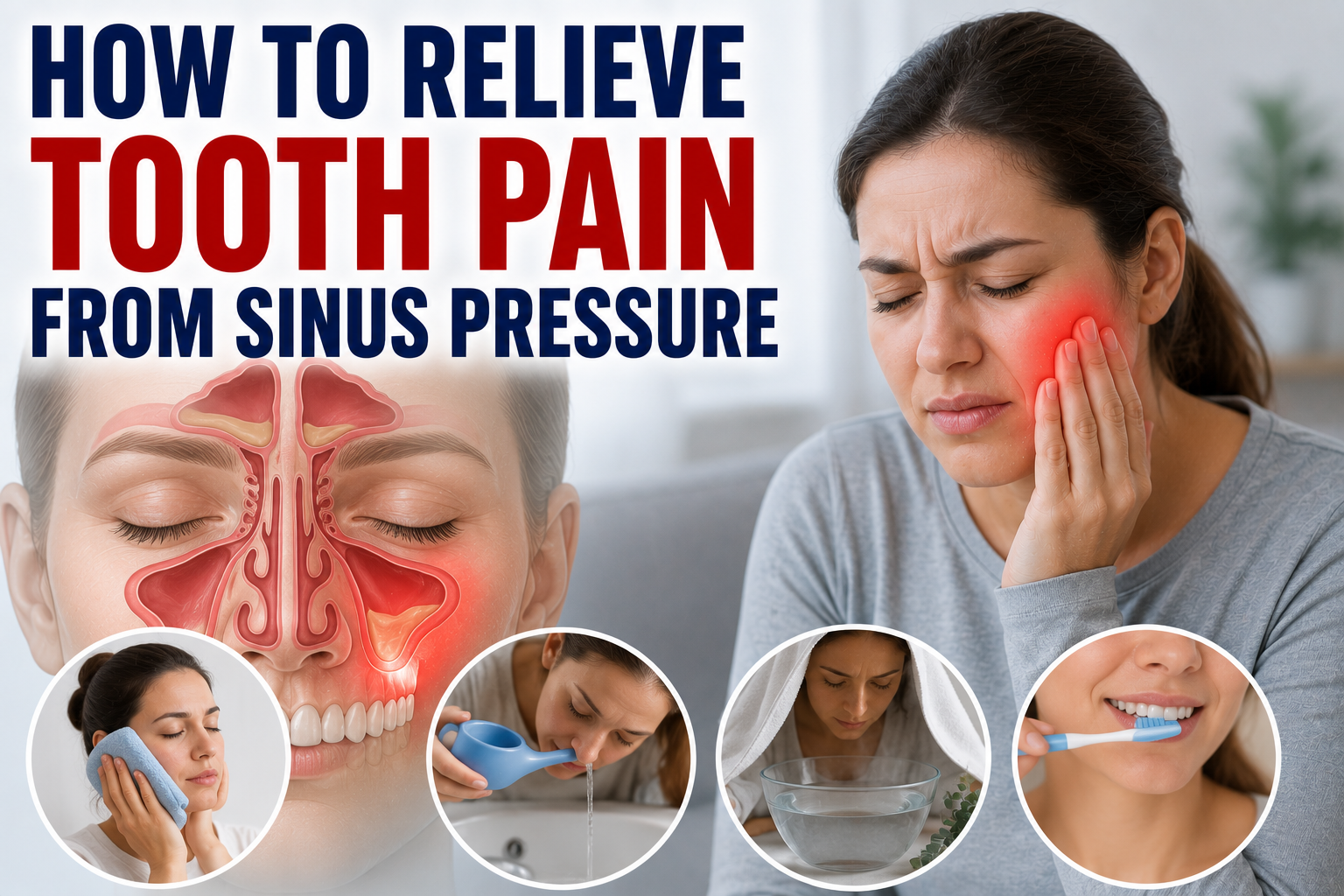
Learning how to relieve tooth pain from sinus pressure starts with understanding why it happens in the first place. Your upper back teeth sit just beneath the maxillary sinuses, so when those cavities fill with fluid and swell, the pressure presses directly on the nerves in your tooth roots. That dull, achy pain across several upper teeth — instead of one sharp spot — is usually the giveaway that sinus pressure, not a cavity, is the real cause.
This guide walks through what causes sinus-related tooth pain, how to tell it apart from a dental problem, and which remedies actually bring relief. You’ll also find warning signs that mean it’s time to call a doctor or dentist instead of waiting it out.
Key Takeaways
- Sinus pressure causes tooth pain when swollen maxillary sinuses press against the roots of your upper molars and premolars.
- Pain that spreads across multiple upper teeth at once — rather than one isolated tooth — points to a sinus source rather than a cavity.
- Nasal decongestants, saline rinses, and steam inhalation relieve sinus pressure and, in turn, ease the tooth pain within 24–48 hours for most people.
- Odontogenic sinusitis (sinus infection caused by a dental problem) accounts for roughly 10% of sinusitis cases (Source: Dentistry Today), so a dental exam matters if symptoms persist.
- Tooth pain lasting more than 7–10 days, or paired with fever and swelling, needs evaluation by a dentist or physician.
Why Sinus Pressure Causes Tooth Pain
Your maxillary sinuses are air-filled spaces located directly above your upper back teeth. The roots of those molars and premolars sit extremely close to the sinus floor — in some people, separated by only a thin layer of bone.
When you catch a cold, allergy flare-up, or sinus infection, the lining of the maxillary sinus swells and fills with mucus. That swelling increases pressure inside the cavity, and because the sinus floor sits right above your tooth roots, the pressure transfers straight to the nerves inside those teeth.
- Congestion and fluid buildup stretch the sinus lining, increasing internal pressure.
- Nerve proximity means upper teeth feel that pressure as dull, radiating pain.
- Bending forward or lying down often intensifies the ache because fluid shifts and pools near the sinus floor.
Pro Tip: If tooth pain gets noticeably worse when you tilt your head forward or lie flat, that’s one of the clearest signs your teeth are reacting to sinus pressure rather than a dental issue.
Sinus Tooth Pain vs. a Cavity: How to Tell the Difference
Distinguishing sinus tooth pain causes from an actual dental problem saves you an unnecessary trip — or helps you catch a real cavity early. The two conditions feel different once you know what to check.
| Feature | Sinus-Related Tooth Pain | Cavity or Dental Infection |
| Location | Multiple upper teeth, both sides possible | Usually one specific tooth |
| Pain pattern | Dull, pressure-like ache | Sharp, throbbing, or triggered by hot/cold |
| Other symptoms | Nasal congestion, facial pressure, postnasal drip | Visible decay, gum swelling near one tooth |
| Worsens with | Bending forward, lying down | Chewing, biting, temperature changes |
| Improves with | Decongestants, sinus treatment | Doesn’t respond to sinus remedies |
If decongestant use brings noticeable relief within a day, that response itself is useful diagnostic information — cavities don’t improve from clearing your sinuses.
Fast At-Home Relief for Sinus-Related Tooth Pain
Once you’ve connected the pain to sinus pressure, the fastest relief comes from treating the sinus congestion directly rather than the tooth itself. These steps target the actual source of the pressure.


Step 1: Use a Saline Nasal Rinse
A saline rinse thins mucus and flushes swollen sinus passages, which reduces the pressure sitting on your tooth roots. Use a neti pot or saline spray once or twice daily during a flare-up.
Step 2: Apply Warm, Moist Heat to the Face
Holding a warm compress over your cheeks and upper jaw for 10–15 minutes encourages sinus drainage and eases the ache in your upper teeth. Repeat 3–4 times a day as needed.
Step 3: Try Steam Inhalation
Breathing in steam from a hot shower or a bowl of hot water loosens thick mucus and opens congested sinus passages. This is one of the quickest ways to feel pressure — and tooth pain — start to lift.
- Saline rinse: flushes mucus and reduces sinus swelling directly.
- Warm compress: improves local blood flow and encourages drainage.
- Steam inhalation: loosens mucus for faster sinus clearing.
- Staying upright: avoids the pooling effect that worsens pain when lying flat.
Warning: Over-the-counter pain relievers can mask tooth pain temporarily, but they don’t treat the sinus pressure causing it. Relying on painkillers alone without addressing congestion can delay you noticing a worsening infection.
Nasal and Sinus Treatments That Also Ease Tooth Pain
Beyond home remedies, several over-the-counter and medical treatments target sinus pressure tooth pain remedy needs more directly, especially when congestion is severe.
Oral or nasal decongestants shrink swollen nasal tissue, which reduces pressure on the sinus floor and, in turn, on your tooth roots. Antihistamines help if allergies are driving the congestion rather than a viral or bacterial infection.
- Decongestant sprays or tablets reduce sinus swelling within hours for many people.
- Antihistamines address allergy-driven congestion specifically.
- NSAIDs like ibuprofen reduce both inflammation and pain simultaneously, unlike acetaminophen alone.
Nasal decongestant sprays shouldn’t be used for more than three consecutive days, since prolonged use can trigger rebound congestion that makes symptoms worse. If a spray-based decongestant isn’t cutting it after a few days, that’s a signal to check in with a doctor about an oral option or possible sinus infection.
When Sinus Tooth Pain Signals Something More Serious
Most sinus infection tooth pain resolves as congestion clears, but a few warning signs mean it’s time to stop self-treating.
Warning — See a Doctor or Dentist If You Notice:
- Pain lasting longer than 10 days despite home treatment
- Fever, facial swelling, or pain that’s worse on one side only
- Tooth pain that started before any cold or allergy symptoms
- Visible tooth decay, a cracked tooth, or gum swelling near one specific tooth
Odontogenic sinusitis — a sinus infection actually caused by a dental problem, such as an infected molar root — is the reverse scenario worth ruling out. According to a clinical study published in International Journal of Oral and Maxillofacial Surgery (2021), the first molar was the tooth most often affected, involved in about 42.6% of cases, which is why a dental X-ray is sometimes the more useful first step than another round of decongestants.
How to Prevent Sinus Pressure From Triggering Tooth Pain Again
Preventing recurring tooth pain sinus pressure relief needs usually comes down to managing whatever triggers your sinus congestion in the first place.
- Treat allergies proactively with daily antihistamines during high-pollen seasons rather than waiting for symptoms to build.
- Run a humidifier in dry indoor air to keep sinus passages from drying out and becoming more prone to swelling.
- Stay hydrated since thin mucus drains more easily than thick, dehydrated mucus.
- Address chronic sinus issues with an ENT if congestion recurs multiple times per year.
Chronic sinusitis affects far more people than most realize. According to National Health Interview Survey data cited by the CDC (2019), roughly 12–14.6% of U.S. adults report having chronic sinusitis, and women (15.0%) are diagnosed more often than men (8.8%). If you fall into a high-frequency group, prevention habits matter more than one-off remedies.
Frequently Asked Questions
Can sinus pressure really cause tooth pain?
Yes. The maxillary sinuses sit directly above the roots of your upper back teeth, so swelling and pressure inside the sinus transfer straight to those tooth nerves, creating a dull, widespread ache.
How do you know if tooth pain is from your sinuses or a cavity?
Sinus pain usually affects several upper teeth at once and worsens when you bend forward, while cavity pain is sharp, localized to one tooth, and triggered by biting or temperature.
What is the fastest way to relieve sinus tooth pain?
A combination of a saline nasal rinse, a warm facial compress, and an oral decongestant typically brings noticeable relief within 24 hours by directly reducing sinus swelling.
Does sinus-related tooth pain go away on its own?
Often yes, once the underlying congestion clears — usually within a week to 10 days for a common cold or short allergy flare.
What medicine helps tooth pain from sinus pressure?
Decongestants and NSAIDs like ibuprofen work best because they reduce sinus swelling and inflammation together, rather than just masking pain like acetaminophen alone.
Can a dentist tell if tooth pain is from sinuses?
Yes. Dentists can check for tenderness across multiple teeth, review your sinus symptoms, and take an X-ray to rule out decay or infection as the true source.
How long does sinus tooth pain usually last?
It typically resolves alongside the sinus infection or congestion, generally within 7–10 days; pain lasting longer warrants a checkup.
Conclusion
Sinus-related tooth pain feels alarming, but it almost always traces back to swelling in the maxillary sinuses pressing on nearby tooth roots.
Treating the congestion — through saline rinses, decongestants, and steam — typically relieves the tooth pain within a day or two.
If pain persists past 10 days or centers on one tooth, a dental exam rules out a separate underlying issue.
Related Articles
Can Carpal Tunnel Cause Arm Pain? Symptoms, Causes, and Treatment Options
How to Heal Cavities in 2 Days at Home: What Actually Works?
Can a Torodol Shot Help Neck Pain? Benefits, Risks, and What to Expect
Urgent Care for Kidney Stones: When It’s the Right Call
Dehydrated and Back Pain: Causes, Symptoms, Treatment, and Prevention