


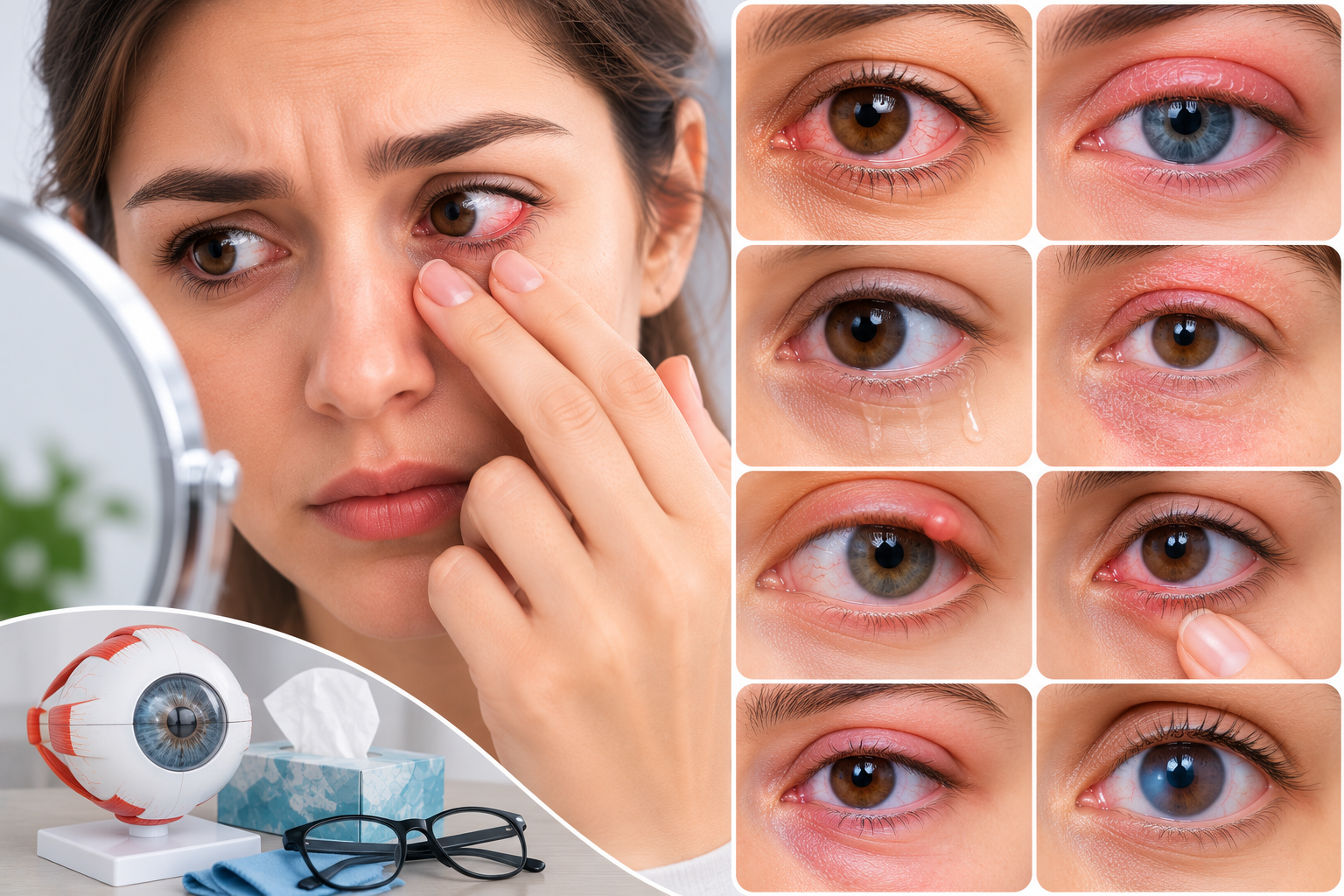
A red, itchy, or watery eye is almost always blamed on pink eye, but that assumption is not always correct. Many eye conditions share the same surface-level symptoms, which makes it easy for people to self-diagnose incorrectly or for a rushed clinical visit to reach the wrong conclusion.
Understanding what is commonly misdiagnosed as pink eye can help you avoid the wrong treatment and catch a more serious problem before it worsens. This guide walks through the twelve conditions most often confused with conjunctivitis, how they differ, and when redness in the eye should be treated as an emergency rather than a routine irritation.
Key Takeaways
- Redness alone does not confirm conjunctivitis; pain, vision changes, and one-sided symptoms often point elsewhere.
- Conditions like dry eye, blepharitis, and corneal abrasion frequently get labeled pink eye by mistake.
- Some misdiagnosed conditions, such as angle-closure glaucoma or herpes zoster infection, are medical emergencies.
- A slit-lamp exam is usually needed to tell these conditions apart with confidence.
- Using pink eye drops or steroids on the wrong condition can delay healing or cause harm.
What Is Pink Eye, Actually?
Pink eye, medically known as conjunctivitis, is inflammation of the thin membrane covering the white part of the eye and inner eyelid. It has three main forms, and each one behaves differently depending on its underlying cause.
Viral vs. Bacterial vs. Allergic Conjunctivitis
Viral conjunctivitis usually starts in one eye and spreads to the other within a few days, producing watery discharge and mild irritation. Bacterial conjunctivitis tends to cause thicker, yellow-green discharge that can crust the eyelids shut overnight. Allergic conjunctivitis affects both eyes at once and is almost always paired with itching, sneezing, or a known allergen trigger.
Classic Symptoms
Typical conjunctivitis symptoms include redness across the white of the eye, a gritty sensation, mild discharge, and eyelid swelling without significant pain. Vision generally stays clear, and light sensitivity is usually mild if present at all. When symptoms deviate from this pattern, such as sharp pain or blurred vision, the diagnosis is worth questioning.
Why Pink Eye Is So Often Misdiagnosed
Pink eye has become a catch-all label because redness is the most visible and recognizable eye symptom to both patients and busy clinicians. Many other conditions share that same red appearance in their early stages, which makes a quick visual assessment unreliable without a closer eye exam.
Self-diagnosis adds another layer of risk, since people often search their symptoms online, see conjunctivitis mentioned first, and assume that is the answer. Primary care visits and urgent care settings, where appointment times are short, can also default to a pink eye diagnosis without ruling out conditions that require specialized equipment to detect properly.
Conditions Commonly Mistaken for Pink Eye
The conditions below all share redness or irritation as a symptom, but each has distinct features that separate it from true conjunctivitis. Reviewing these differences can help you recognize when your eye issue may be something other than pink eye.



Blepharitis
Blepharitis is inflammation along the eyelid margin, often caused by clogged oil glands or a bacterial overgrowth near the eyelashes. It produces redness and crusting similar to conjunctivitis, but the irritation centers on the eyelid edge rather than the eye surface itself. Flaking, greasy debris on the lashes is a strong clue that points away from pink eye.
Dry Eye Syndrome
Dry eye occurs when tear production is insufficient or tears evaporate too quickly, leaving the eye surface irritated and red. Unlike conjunctivitis, dry eye symptoms often worsen throughout the day and improve temporarily with lubricating drops. There is typically no thick discharge, which helps distinguish it from an infectious cause.
Non-Infectious Allergic Reactions
Allergic reactions to cosmetics, contact lens solution, or airborne irritants can mimic conjunctivitis by causing redness, swelling, and watering in both eyes. The key difference is the presence of intense itching without any contagious spread to another person. Removing the suspected trigger usually brings quick relief, which infectious pink eye does not.
Corneal Abrasion or Foreign Body
A scratch on the cornea or a trapped eyelash or debris particle causes sudden redness paired with sharp pain and heavy tearing. This pain is usually far more intense than anything seen in typical conjunctivitis and often worsens with blinking. A foreign body sensation that does not resolve within a day needs prompt evaluation.
Uveitis/Iritis
Uveitis is inflammation of the middle layer of the eye and often causes deep, aching pain along with sensitivity to light. Redness tends to concentrate in a ring around the iris rather than spreading evenly across the white of the eye. Blurred vision accompanying this pattern is a signal that the problem lies deeper than the eye surface.
Episcleritis/Scleritis
Episcleritis and scleritis involve inflammation of the tissue layers beneath the conjunctiva, producing localized redness that can appear patchy rather than uniform. Scleritis, the more severe of the two, causes significant pain that can wake a person at night. Episcleritis is usually milder but still distinguishable from pink eye by its localized pattern.
Keratitis
Keratitis is inflammation or infection of the cornea itself, frequently linked to contact lens overuse or minor injury. It causes pain, light sensitivity, and sometimes a visible white or gray spot on the cornea. Because keratitis can threaten vision if untreated, it is one of the more serious pink eye look-alikes to catch early.
Subconjunctival Hemorrhage
A subconjunctival hemorrhage happens when a small blood vessel breaks under the conjunctiva, creating a bright red patch on the white of the eye. It looks alarming but is usually painless and does not involve discharge or itching. This condition resolves on its own within one to two weeks without treatment.
Comparison Table: Pink Eye vs. Commonly Confused Conditions
| Condition | Key Symptom Difference | Pain Level | Discharge Type | Urgency |
| Viral/Bacterial Conjunctivitis | Gritty irritation, mild swelling | Low | Watery or yellow-green | Routine |
| Blepharitis | Crusting at lash line | Low-Moderate | Flaky debris | Routine |
| Dry Eye Syndrome | Worsens through the day | Low | Minimal to none | Routine |
| Corneal Abrasion | Sharp pain, foreign body feel | High | Watery | Same-day |
| Uveitis/Iritis | Ring redness, blurred vision | Moderate-High | None | Urgent |
| Keratitis | Cornea spot, light sensitivity | High | Minimal | Urgent |
| Subconjunctival Hemorrhage | Bright red patch, painless | None | None | Routine |
| Angle-Closure Glaucoma | Nausea, halos, severe pain | Severe | None | Emergency |
Red Flags: When It’s NOT Pink Eye and Needs Urgent Care
Certain symptoms should never be treated as ordinary pink eye. Sudden vision changes, intense eye pain, significant light sensitivity, or redness confined to one eye with halos around lights all suggest a deeper problem that requires immediate medical attention.
Nausea or vomiting alongside eye pain is a particularly urgent combination linked to angle-closure glaucoma, and delaying care in that scenario risks permanent vision damage.
How Doctors Differentiate These Conditions
Eye care professionals rely on a slit-lamp examination to view the layers of the eye in detail, which is something a mirror or a quick glance cannot replicate.
They also take a thorough symptom history, asking about pain level, discharge type, onset speed, and whether one or both eyes are affected.
In suspected infections, a discharge culture may be taken to confirm whether bacteria are present, which guides more accurate treatment decisions than a visual assessment alone.
Treatment Differences: Why Getting the Diagnosis Right Matters
Using antibiotic drops on a viral infection will not speed up recovery, since viruses do not respond to antibacterial medication.
Steroid drops, sometimes used for allergic reactions, can actually worsen an undiagnosed herpes infection or fungal keratitis, making the condition significantly harder to treat.
Getting an accurate diagnosis first ensures the treatment matches the actual cause, rather than masking symptoms while the underlying issue continues to progress.
FAQs
Can stress cause pink-eye-like symptoms? Stress alone does not cause conjunctivitis, but it can contribute to dry eye symptoms through reduced blinking and poor sleep, which may resemble mild pink eye irritation.
How long does real pink eye last compared to these conditions? Viral conjunctivitis typically resolves within one to two weeks, while conditions like corneal abrasions heal faster and glaucoma or keratitis require prompt medical treatment to resolve safely.
Is redness in one eye or both eyes more telling? Redness in both eyes points more toward allergic or dry eye causes, while one-sided redness with pain is more often linked to abrasion, uveitis, or a localized infection.
When should I go to the ER for eye symptoms? Sudden vision loss, severe pain, nausea with eye pain, or a chemical exposure to the eye all warrant an emergency room visit rather than a routine appointment.
Conclusion
Not every red or irritated eye is pink eye, and treating every case the same way can delay proper care for conditions ranging from dry eye to glaucoma.
Paying attention to pain level, discharge type, and whether one or both eyes are affected offers a much clearer picture than redness alone.
When symptoms are severe, one-sided, or paired with vision changes, seeing an eye care professional for a proper exam remains the safest next step.
RELATED POSTS
How to Sleep After Wisdom Teeth Removal (Safely)
Can Thrush Cause Urinary Tract Infections? The Complete Guide
Can Carpal Tunnel Cause Arm Pain? Symptoms, Causes, and Treatment Options
Lower Back Pain and Heart Attacks: Signs, Symptoms, Causes, and When to Seek Help
Does Hard Water Cause Acne? Understanding the Connection Between Water Quality and Skin Breakouts