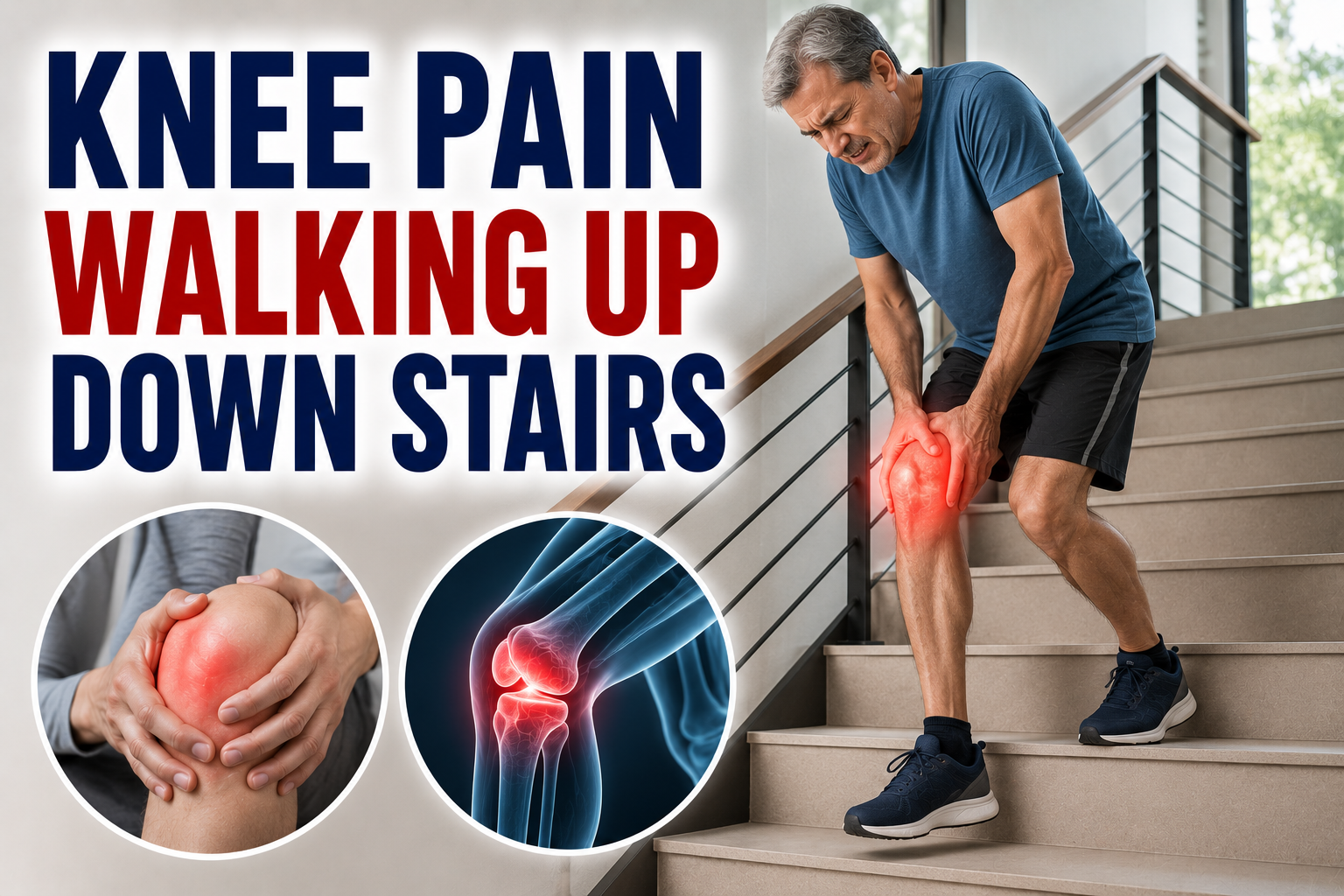
Knee pain walking up down stairs is one of the most common complaints orthopedic clinics hear, and it rarely shows up out of nowhere. You’ve probably noticed the ache appears the moment you plant your foot on a step, then fades once you’re back on flat ground. That pattern is a clue, not a coincidence. This guide breaks down exactly why stairs trigger knee pain, which causes are minor versus serious, and which exercises actually help.
Stairs put far more stress on your knee than walking does, which is why problems that stay hidden on level ground suddenly become obvious. By the end of this article, you’ll know how to tell a manageable issue from one that needs a doctor’s evaluation.
Key Takeaways
- Climbing or descending stairs can load the kneecap joint with roughly three to four times your body weight, according to OrthoIllinois orthopedic surgeon Dr. Mark Barba , since the pressure across the kneecap and joint surfaces can increase to three to four times body weight when going up or down stairs.
- Pain that’s worse going down stairs than up often points to patellofemoral pain syndrome, chondromalacia patella, or a posterior-horn meniscal tear, per Dr. Sabrina Strickland of the Hospital for Special Surgery.
- Under-50 patients are more likely to have chondromalacia, patellar tendinitis, or malalignment, while osteoarthritis becomes a more likely cause after age 50.
- Quadriceps and hip strengthening are the first-line treatment recommended across nearly every orthopedic source reviewed for this guide.
- Persistent pain lasting more than four to six weeks, or pain with swelling, locking, or the knee giving way, warrants a professional evaluation rather than continued self-management.
- You generally don’t need to avoid stairs entirely — smart modification beats total avoidance.
Why Stairs Cause More Knee Pain Than Walking
Level walking is gentle on your knees compared to stairs. Each step up or down forces your kneecap to grind against the femur with dramatically more pressure than standing or strolling produces.
Dr. Barba explains that stair activity places significant stress on the knee joint, often revealing problems that may not be noticeable during normal walking because ordinary walking simply doesn’t generate enough force to expose them. This is why many people feel completely fine on flat ground but wince the moment they hit a staircase.
- Ascending stairs requires your quadriceps to contract forcefully to lift your body weight, compressing the kneecap against the thigh bone.
- Descending stairs asks your quadriceps to control your body weight eccentrically while lengthening — a more demanding motion that loads the patellofemoral joint with roughly 3.5 times your body weight, according to Dr. Strickland.
- Any existing cartilage, tendon, or alignment issue gets amplified under this extra load, turning a minor problem into a noticeable one.
Pro Tip: If your pain is worse descending than ascending, mention that specific detail to your doctor — it narrows the diagnosis significantly and speeds up evaluation.
Knee Pain Going Up Stairs: The Most Common Causes
Pain that hits specifically on the way up usually centers on the front of the knee. Dr. Strickland notes that knee pain when going up stairs almost always points to the front of the knee — the kneecap and the cartilage beneath it.
Patellofemoral Pain and Chondromalacia Patella
Often called “runner’s knee,” this involves softened or irritated cartilage under the kneecap. It produces a dull ache that worsens with stairs and prolonged sitting with bent knees.



Patellar Tendinitis
Overuse of the tendon connecting the kneecap to the shinbone causes localized pain just below the kneecap, typically worse with jumping, squatting, or stair climbing.
Early Knee Osteoarthritis
Osteoarthritis can cause stair-related knee pain, especially in patients over 50, as cartilage gradually wears down and joint surfaces lose their cushioning.
Patellar Malalignment
When the kneecap doesn’t track smoothly in its groove, it creates uneven pressure that flares up specifically under load — like climbing.
Knee Pain Going Down Stairs: Why It Often Feels Worse
Many people report their knee actually hurts more descending than climbing, and there’s a clear biomechanical reason for that.
Dr. Strickland’s analysis identifies patellofemoral pain syndrome, chondromalacia patella, and a posterior-horn meniscal tear as the three leading causes of descent-specific pain. Because going downstairs demands deep knee bending at the top of each step, it places extra strain on the back portion of the meniscus — explaining why a meniscus tear can show up primarily as pain with descending stairs, particularly when the tear sits toward the rear of the cartilage pad.
Warning: If descending pain comes with your knee catching, locking, or briefly giving way, treat that as a mechanical red flag rather than routine soreness — these symptoms suggest structural involvement like a meniscus tear rather than simple muscle fatigue.
Other Contributing Factors Worth Ruling Out
Not every case traces back to the knee joint itself. Several outside factors can quietly drive stair-related pain.
| Factor | How It Affects Stair Pain |
| Weak quadriceps or hip muscles | Poor shock absorption shifts load directly onto joint cartilage |
| Flat feet or poor arch support | Changes leg alignment, increasing stress on the kneecap |
| High heels or unsupportive shoes | Shifts weight forward, placing extra strain on your knees and increasing pain on stairs |
| Excess body weight | Multiplies the already-high forces stairs place on the joint |
| Previous ligament injury (ACL, PCL, or collateral) | Leaves the joint less stable under the twisting load stairs require |
When to See a Doctor vs. When to Self-Manage
Not every twinge on the stairs needs a same-week orthopedic appointment. Use this comparison to gauge urgency.
| Situation | Self-Manage First | See a Doctor Promptly |
| Mild dull ache, no swelling | Try rest, ice, and modification for 4–6 weeks | — |
| Pain after a specific fall or twist | — | Evaluate within days |
| Swelling, locking, or knee giving way | — | Evaluate promptly |
| Pain lasting beyond 4–6 weeks despite modification | — | Schedule an evaluation |
| Occasional stiffness after long sitting | Usually normal; monitor | — |
Dr. Strickland’s general guidance reflects this same threshold: persistent stair-related knee pain that lasts more than a few weeks, swells, or follows an injury should be evaluated by an orthopedic specialist.
How to Climb and Descend Stairs to Protect Your Knees
Small technique adjustments can meaningfully reduce pain while you address the underlying cause.
Going Up
- Step with your whole foot, not just your toes, to avoid compressing the joint.
- Push off through your outer heel to engage the glutes and reduce knee strain.
- Keep your knee tracking directly over your foot rather than angled inward.
Going Down
- Lead with the unaffected leg when pain is one-sided.
- Use the handrail to offload some body weight from the joint.
- Take one stair at a time rather than forcing a normal stride if pain flares.
Dr. Strickland recommends this exact short-term approach: use one stair at a time, lead with the unaffected leg, and use a handrail until pain settles.
Exercises That Help Knee Pain on Stairs
Quadriceps and hip strengthening consistently appear as the first-line treatment across orthopedic sources, and the American Academy of Orthopaedic Surgeons (AAOS) backs this approach directly.
- Quad sets: Tighten the thigh muscle with the knee straight; hold several seconds and release. AAOS recommends this as a foundational strengthening move.
- Straight-leg raises: AAOS identifies these as an effective exercise for strengthening the quadriceps muscles, which stabilize the kneecap.
- Mini squats in a pain-free range: Builds strength without pushing the joint past its comfort threshold.
- Hip abductor and external rotator stretches: AAOS notes that stretching the external rotator muscles around the hip joint supports better patellar tracking.
A 2024 clinical study published in Diagnostics found that structured stair-climbing training improved function scores in knee osteoarthritis patients over a 12-week program (Lee et al., 2024, DOI: 10.3390/diagnostics14182060), reinforcing that targeted, gradual loading — not total avoidance — supports long-term recovery.
Pro Tip: Stop any exercise immediately if it sharpens your pain rather than producing normal muscle fatigue. AAOS is explicit on this point: if an exercise causes pain, stop the exercise and talk to your doctor or physical therapist.
Treatment Options Beyond Exercise
When strengthening alone isn’t enough, orthopedic providers typically layer in additional options based on the diagnosis:
- Activity modification — temporarily reducing stair use or high-impact activity while healing.
- Weight management — AAOS notes that for patellofemoral arthritis, losing just a few pounds can make a big difference in the amount of stress you place on your knee.
- Bracing or supportive footwear — improves stability and reduces uneven loading.
- Anti-inflammatory medication or injections — used under medical supervision for inflammation control.
- Surgery — reserved for cases where conservative treatment fails and imaging confirms a structural problem requiring repair.
Frequently Asked Questions
Why does my knee hurt more going down stairs than up?
Descending loads the kneecap with roughly 3.5 times your body weight through eccentric quadriceps control, which is more demanding than the concentric effort of climbing. This is why cartilage or meniscus problems often surface first on the way down.
What does it mean if your knee hurts every time you climb stairs?
Consistent stair pain usually points to patellofemoral irritation, cartilage softening (chondromalacia), or early arthritis. A one-time evaluation with imaging can pinpoint which one is driving your symptoms.
Is it normal for your knees to hurt going up and down stairs as you age?
Occasional stiffness can be common, but persistent pain isn’t something to simply accept. Osteoarthritis risk rises after 50, but it’s still a diagnosable, manageable condition rather than an inevitable part of aging.
What exercises help knee pain on stairs?
Quad sets, straight-leg raises, and pain-free mini squats are the most commonly recommended starting exercises. Hip strengthening also improves how your kneecap tracks during stair use.
When should I worry about knee pain on stairs?
Seek evaluation if pain persists beyond four to six weeks, follows a specific injury, or comes with swelling, locking, or your knee giving way.
Can weak quads cause knee pain on stairs?
Yes. Weak quadriceps reduce shock absorption around the kneecap, shifting more load directly onto joint cartilage and increasing pain during stair use.
Does knee pain on stairs mean arthritis?
Not necessarily. Younger, active patients more often have chondromalacia, tendinitis, or malalignment, while arthritis becomes more likely — though still not guaranteed — after age 50.
Conclusion
Knee pain walking up down stairs almost always has an identifiable cause, from cartilage irritation to muscle weakness to early arthritis, and most cases respond well to targeted strengthening and smart activity modification.
The biggest mistake is waiting out persistent pain instead of getting a proper evaluation when red-flag symptoms appear
Related Posts
How Long Until a Tooth Infection Kills You? The Real Timeline
How Long Does a Fractured Toe Take to Heal? (And What Affects Your Recovery)
Does Sleep Apnea Go Away? What Really Happens