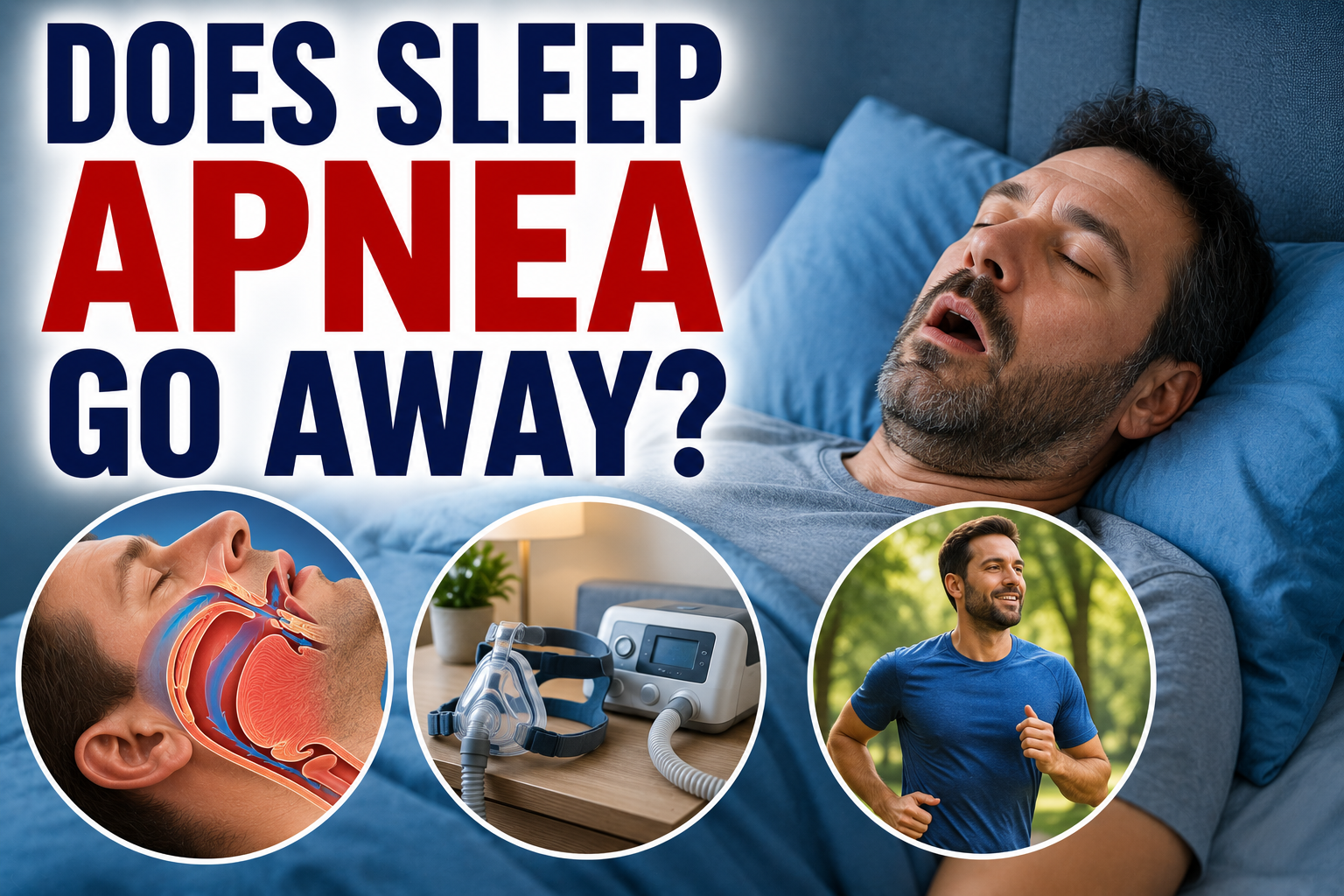
Does sleep apnea go away on its own — or is it something you’ll manage for life? Most people ask this after a frustrating night of gasping awake, a partner’s complaint about loud snoring, or a new diagnosis they weren’t expecting. The honest answer depends on what’s causing it, and this guide breaks down exactly when sleep apnea can improve, when it’s likely permanent, and what actually moves the needle.
You’ll find evidence-based answers here, not vague reassurance. We’ll cover the causes that can reverse with lifestyle changes, the cases that need ongoing treatment, and what doctors actually recommend before you try anything on your own.
Key Takeaways
- Sleep apnea rarely disappears completely without intervention, especially in adults with obstructive sleep apnea (OSA).
- Significant weight loss can reduce or resolve OSA symptoms in people whose excess weight is a major contributing factor.
- CPAP therapy remains the most effective treatment, but it manages symptoms rather than curing the underlying condition.
- Mild cases sometimes improve with positional therapy, weight management, or treating nasal congestion.
- Untreated sleep apnea raises long-term risks for heart disease, high blood pressure, and daytime accidents.
- Children’s sleep apnea often resolves after tonsil or adenoid removal, unlike most adult cases.
Does Sleep Apnea Go Away on Its Own?
For most adults, sleep apnea does not resolve without some form of intervention. Obstructive sleep apnea (OSA), the most common type, happens because throat muscles relax and block the airway during sleep — a physical issue that typically doesn’t correct itself spontaneously.
That said, “won’t go away on its own” doesn’t mean “untreatable.” Many of the underlying contributors — excess weight, alcohol use before bed, sleeping position, nasal blockage — are things you can actively change.
Pro Tip: Track your symptoms (snoring, gasping, morning headaches, daytime fatigue) for two weeks before your doctor visit. This helps clinicians judge severity faster during a sleep apnea go away on its own evaluation.
Can Sleep Apnea Be Cured, or Just Managed?
Whether sleep apnea can be cured depends heavily on its root cause. According to the National Heart, Lung, and Blood Institute (NHLBI), obstructive sleep apnea is generally a chronic condition that requires ongoing management rather than a one-time fix. (Source: NHLBI, nhlbi.nih.gov)
There are exceptions worth knowing:
- Weight-related OSA often improves substantially after meaningful weight loss, sometimes resolving entirely in milder cases.
- Pregnancy-related apnea frequently disappears after childbirth, once hormonal and weight changes reverse.
- Pediatric apnea caused by enlarged tonsils or adenoids often resolves after surgical removal.
- Alcohol or sedative-induced apnea can improve quickly once the substance is removed from the nightly routine.
Warning: Stopping CPAP therapy because you “feel fine” is risky. Apnea events can return immediately even when symptoms feel mild, since the airway obstruction itself hasn’t changed.



Is Sleep Apnea Permanent for Most Adults?
For middle-aged and older adults — the group most commonly diagnosed — sleep apnea is usually a long-term condition. Anatomical factors like a narrow airway, recessed jaw, or enlarged tonsils don’t change on their own with age.
According to the American Academy of Sleep Medicine (AASM), obstructive sleep apnea prevalence increases with age and excess body weight, making it more likely to persist without active management. (Source: AASM, aasm.org)
Hypothetical Example (for illustration purposes):
A 45-year-old man diagnosed with moderate OSA loses 30 pounds over a year through diet and exercise. His follow-up sleep study shows his apnea-hypopnea index (AHI) has dropped from the moderate range into the mild range — meaningful improvement, though not a complete cure.
Note: This scenario is illustrative. Actual results vary by individual physiology, weight loss amount, and airway anatomy.
Can You Reverse Sleep Apnea by Losing Weight?
Weight loss is one of the most reliable ways to reduce sleep apnea severity in people who are overweight. Fat deposits around the neck and throat narrow the airway, so shedding that tissue can directly ease obstruction.
How Much Weight Loss Actually Helps
Even modest, sustained weight loss can lower apnea-hypopnea index scores, according to research published by the American Academy of Sleep Medicine. (Source: AASM Clinical Guidelines) Results vary by starting weight, fat distribution, and how much is lost.
- A 10% reduction in body weight is often cited by sleep specialists as a meaningful threshold for symptom improvement.
- Combining weight loss with positional therapy (avoiding back-sleeping) can compound the benefit.
- Some patients no longer need CPAP after major weight loss, but should confirm this with a repeat sleep study — not guesswork.
Mild Sleep Apnea Treatment Without CPAP
Mild cases sometimes respond well to non-CPAP approaches, particularly when an anatomical cause isn’t severe. This doesn’t mean skipping diagnosis — it means having more options once a doctor confirms severity.
Common approaches for mild sleep apnea treatment include:
- Positional therapy — wearable devices or pillows that discourage back-sleeping, since apnea often worsens in that position.
- Oral appliances — custom-fitted mouthguards that reposition the jaw to keep the airway open, fitted by a dentist trained in sleep medicine.
- Nasal treatment — addressing chronic congestion or a deviated septum, which can worsen airway obstruction.
- Reducing alcohol and sedatives, especially within a few hours of bedtime, since these relax throat muscles further.
What Happens If Sleep Apnea Goes Untreated?
Leaving sleep apnea untreated isn’t a neutral choice — the risks accumulate over time. The Centers for Disease Control and Prevention notes that untreated sleep apnea is linked to higher risk of high blood pressure, heart disease, and stroke. (Source: CDC, cdc.gov)
| Risk Area | Effect of Untreated Sleep Apnea |
| Cardiovascular health | Increased risk of high blood pressure and heart strain |
| Daytime function | Higher accident risk from chronic fatigue |
| Metabolic health | Associated with insulin resistance and weight gain |
| Mental health | Linked to higher rates of depression and irritability |
Warning: Daytime drowsiness from untreated apnea is a documented factor in drowsy-driving accidents. If you’re falling asleep at red lights, treat this as urgent, not optional.
Does Sleep Apnea Come Back After Weight Loss or Surgery?
Improvement doesn’t always mean permanent resolution. Weight regain is one of the most common reasons sleep apnea symptoms return after initial improvement — the airway narrows again as fat tissue returns.
Surgical options (like uvulopalatopharyngoplasty) can reduce severity but don’t guarantee a permanent fix either. According to Mayo Clinic, surgery is generally considered when CPAP and oral appliances haven’t worked, and outcomes vary by procedure and individual anatomy.
How to Get an Accurate Diagnosis Before Trying to “Fix” It Yourself
Self-treating based on snoring alone is a common mistake. A formal sleep study — in a lab or at home — measures your apnea-hypopnea index and determines real severity, which shapes every treatment decision that follows.
What a Sleep Study Measures
- Apnea-hypopnea index (AHI): the number of breathing interruptions per hour of sleep.
- Oxygen saturation levels: how much your blood oxygen drops during apnea events.
- Sleep stage disruption: how often apnea is pulling you out of deep, restorative sleep.
Pro Tip: Ask your doctor whether a home sleep test is appropriate for your symptoms — it’s often cheaper and more convenient than an in-lab study for straightforward cases.
FAQ: Does Sleep Apnea Go Away?
Can sleep apnea go away on its own?
Rarely in adults. Most obstructive sleep apnea needs treatment or significant lifestyle change, like weight loss, to meaningfully improve.
Can you reverse sleep apnea by losing weight?
Yes, often. Substantial weight loss can reduce or sometimes resolve mild-to-moderate OSA, though results vary by individual.
Does sleep apnea ever fully go away?
It can in specific cases — pregnancy-related apnea, pediatric apnea from enlarged tonsils, or mild cases tied to a reversible cause.
What happens if sleep apnea is left untreated?
Risks include high blood pressure, heart disease, daytime accidents, and worsening fatigue over time, according to CDC data.
Can mild sleep apnea go away without CPAP?
Sometimes, through positional therapy, oral appliances, or treating nasal congestion — but a sleep study should confirm severity first.
Does sleep apnea come back after weight loss?
It can, particularly if weight is regained. Periodic follow-up sleep studies help confirm whether symptoms have truly resolved.
Is sleep apnea a lifelong condition?
For many adults, yes — especially when caused by airway anatomy. It’s typically managed long-term rather than permanently cured.
The Bottom Line
Sleep apnea rarely goes away on its own, but it doesn’t always have to be a lifelong condition. Mild cases may improve with weight loss, sleeping in a different position, or treating the underlying cause.
However, symptoms like loud snoring and daytime fatigue shouldn’t be ignored. The best way to know if you have sleep apnea is to get a proper medical evaluation and diagnosis. Early treatment can improve sleep quality and reduce the risk of serious health problems.
Related Posts
Can Thrush Cause Urinary Tract Infections? The Complete Guide
How Long Until a Tooth Infection Kills You? The Real Timeline
Burning Eyes: Causes, Relief, and When to See a Doctor
Can a Torodol Shot Help Neck Pain? Benefits, Risks, and What to Expect
Why Is My Stomach Bigger After Hernia Surgery? Causes, Recovery, and When to Worry