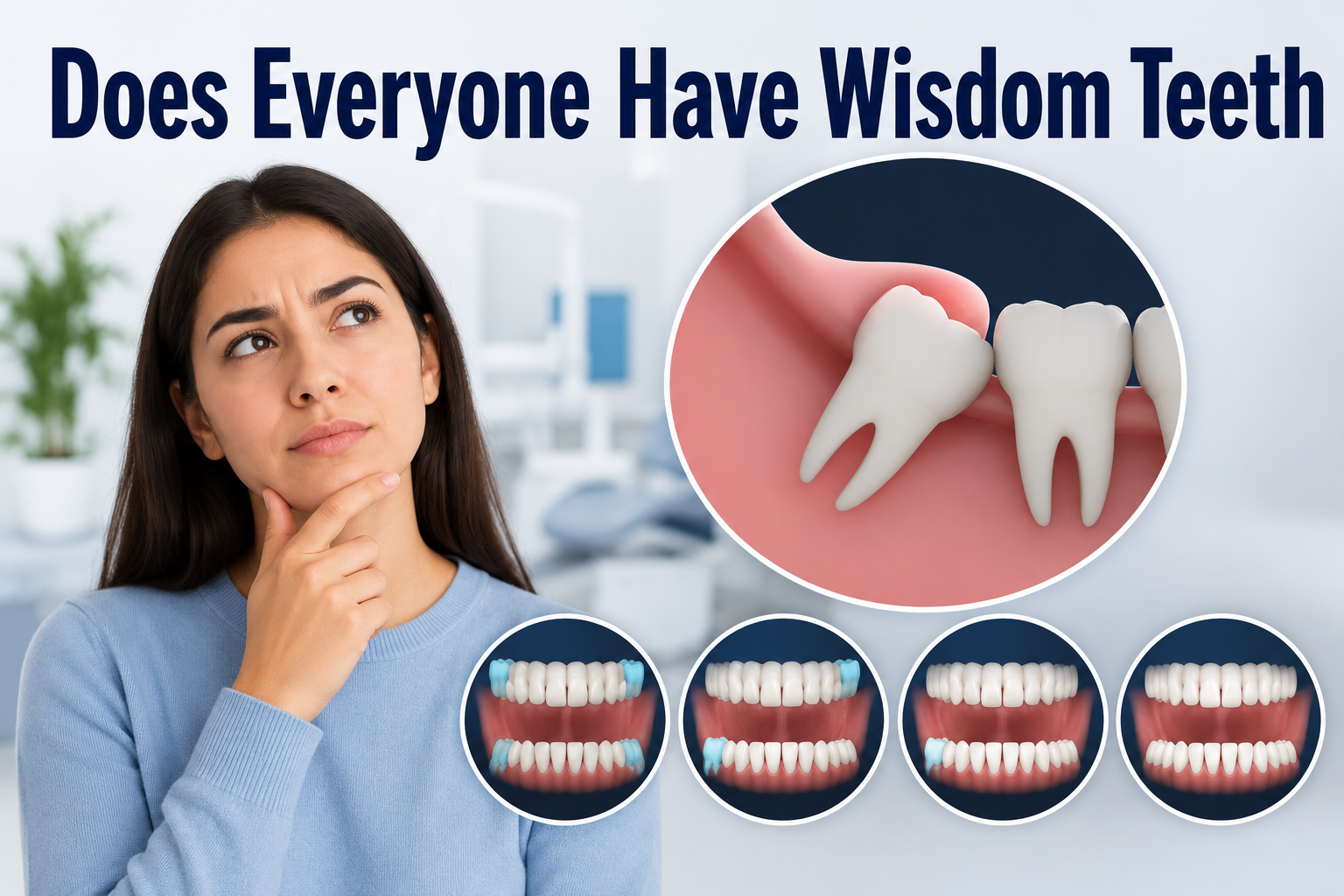
Does everyone have wisdom teeth? Not according to dental research — a significant share of people never grow all four third molars. A blank space on your dental X-ray can feel confusing, especially when friends compare notes about their own extractions. This guide breaks down exactly who develops wisdom teeth, who doesn’t, and why, so you can understand your own results with confidence.
You’ll find real prevalence numbers by population, the genetics behind missing third molars, and clear signs that indicate whether yours are present, impacted, or already gone.
| Key Takeaways Roughly 20–30% of people worldwide never develop one or more wisdom teeth, a condition dentists call third molar agenesis.A review of 63,314 patients across 92 studies found a global agenesis rate of 22.63%.Women are slightly more likely than men to be missing at least one wisdom tooth.About 90% of Americans will develop at least one impacted wisdom tooth that eventually needs attention.By age 25, roughly half of privately insured Americans have had at least one wisdom tooth extracted.Only a panoramic dental X-ray can confirm with certainty whether your wisdom teeth are present, impacted, or missing. |
What Are Wisdom Teeth, and Why Do Humans Have Them?
Wisdom teeth, or third molars, are the last set of teeth to develop in the human mouth. They typically sit in the very back corners, one in each quadrant of the upper and lower jaw.
Anthropologists believe early humans needed these extra molars to grind tough, fibrous foods like roots and raw meat. As diets softened and cooking became common, human jaws gradually grew smaller — leaving less room for a full set of third molars.
| Pro Tip Ask your dentist for a copy of your panoramic X-ray. Comparing it side-by-side with a labeled dental chart makes it much easier to see exactly which teeth you have. |
Does Everyone Have Wisdom Teeth? What the Research Shows
The short answer is no. Third molars are the most commonly missing teeth in the human mouth, and their absence — known as wisdom teeth agenesis — is considered a normal variation, not a disorder.
According to a Harvard University dissertation reviewed by Colgate (2026), which analyzed 92 studies covering 63,314 subjects, the global rate of third molar agenesis is 22.63%. The same review found that women were more likely than men to be missing one or more wisdom teeth (Source: Colgate Oral Care).
A separate genetics study published in PMC (2021) found that the absence of one or more third molars occurs in approximately 20–30% of the population, making it far more common than agenesis of any other permanent tooth (Source: National Library of Medicine).
Prevalence also varies widely by geography and ancestry, as the table below shows.



| Population Group | Approx. Agenesis Rate | Source |
| Global average | 22.6% | Harvard dissertation, via Colgate |
| India | 11.5%–35.1% | PMC (2024) regional studies |
| Bangladesh | 38.4% | Medicover Genetics (2023) |
| South Korea | 41% | Medicover Genetics (2023) |
| Black African populations | 10%–11% | ScienceInsights (2025) |
| Indigenous Mexican populations | Up to 100% | Medicover Genetics (2023) |
Why Some People Have Wisdom Teeth Agenesis (No Third Molars)
Genetics are the leading explanation for missing wisdom teeth. Specific genes involved in tooth and facial development — including AXIN2, MSX1, and PAX9 — appear to influence whether third molars form at all.
A twin study cited by Medicover Genetics (2023) found that identical twins shared third molar agenesis slightly more often than fraternal twins, reinforcing that heredity plays a real role (Source: Medicover Genetics).
Jaw Size and Evolutionary Pressure
Researchers have also linked missing third molars to smaller overall jaw and face size. A PMC study on facial structure found that each missing wisdom tooth corresponded with a measurable reduction in jaw dimensions, suggesting agenesis is tied to a broader developmental pattern rather than a random glitch.
- Genetics: family history is the strongest predictor of missing wisdom teeth.
- Jaw and face size: smaller jaw structures correlate with fewer third molars.
- Ancestry and geography: agenesis rates differ sharply between population groups.
- Other tooth agenesis: people missing other teeth are more likely to also miss wisdom teeth.
How Many Wisdom Teeth Do Most People Actually Get?
Most people are born with the potential to develop up to four wisdom teeth — one in each back corner of the mouth. But
industry data compiled by TriAgenics suggests that around 93% of teenagers will have at least one third molar develop, while roughly 7% experience complete wisdom tooth agenesis, meaning none form at all (Source: TriAgenics Wisdom Teeth Economics).
Between those two extremes sits the majority of the population: people with two, three, or four wisdom teeth, in almost any combination. It’s common to have, for example, both lower third molars but only one upper one.
| Hypothetical Example (for illustration purposes): Imagine “Sarah,” a 22-year-old getting a routine dental check-up. Her dentist takes a panoramic X-ray and finds only two wisdom teeth present — the lower two never formed. Sarah has no pain or crowding, so her dentist recommends monitoring rather than removal. Note: This scenario is illustrative. Actual results vary by individual anatomy, genetics, and dental history. |
Signs You May Be Missing Wisdom Teeth — or That Yours Are Impacted
Because third molars sit so far back in the jaw, it’s genuinely hard to know their status without imaging. A few clues can point you in the right direction, though.
- No new molars by your mid-20s: wisdom teeth usually erupt between ages 17 and 25, per dental research.
- Smooth gum tissue in the back corners: if there’s no bulge, swelling, or partial tooth visible, agenesis is possible.
- Recurring dull pressure or jaw ache: this can signal an impacted tooth pressing against nearby structures.
- A dentist’s note on a past X-ray: many people already have this information in old dental records and simply forget it.
| Warning Never assume you don’t have wisdom teeth just because you can’t feel them. Impacted teeth stay hidden below the gumline and bone, so only an X-ray can confirm whether they’re present. |
Do You Need to Remove Wisdom Teeth If You Have Them?
Not automatically. Dental associations have moved away from routinely pulling every wisdom tooth and now generally recommend removal only when a tooth is impacted, decayed, crowding other teeth, or causing infection.
According to the American Association of Oral and Maxillofacial Surgeons, roughly 90% of Americans will develop at least one impacted wisdom tooth that eventually needs extraction (Source: AAOMS, via Liberty Oral Surgery).
Separately, a Frontiers in Dental Medicine analysis of US insurance claims found that about 50% of privately insured patients undergo at least one third-molar extraction by age 25 (Source: Frontiers, 2022).
A YouGov survey (2025) also found that two-thirds of Americans who turned 20 before the year 2000 had their wisdom teeth removed, compared with lower rates among younger adults — reflecting the shift toward more selective, case-by-case removal (Source: YouGov).
If your wisdom teeth are fully erupted, properly aligned, and easy to clean, many dentists will simply monitor them at regular checkups rather than recommend surgery.
How to Find Out for Sure: Diagnosis and Next Steps
A routine dental exam paired with a panoramic X-ray is the only reliable way to know exactly how many wisdom teeth you have, where they sit, and whether any are impacted.
What to Ask at Your Next Dental Visit
- Request to see your panoramic X-ray on screen and have your dentist point out each third molar.
- Ask directly whether any wisdom teeth are impacted, partially erupted, or missing entirely.
- If a tooth is missing, ask whether it’s true agenesis or simply hasn’t erupted yet.
- Discuss a monitoring schedule if removal isn’t currently necessary.
For a deeper look at what removal involves and what it costs, see our guide to wisdom teeth removal cost and recovery.
Frequently Asked Questions
Does everyone have wisdom teeth?
No. Research shows roughly 20–30% of people never develop one or more third molars, a trait called agenesis. Genetics and jaw size both influence whether they form.
What percentage of people are missing wisdom teeth?
A global review of over 63,000 patients found an average agenesis rate of 22.63%, though country-level rates range from about 11% to over 40%.
Is it normal to not have wisdom teeth?
Yes, it’s completely normal and not a sign of a health problem. Missing wisdom teeth doesn’t affect chewing, jaw function, or bone density for most people.
How do I know if I have wisdom teeth?
A panoramic dental X-ray is the only reliable way to confirm. Wisdom teeth can be present but impacted below the gumline, so a visual exam alone isn’t enough.
How many wisdom teeth do most people have?
Most people can develop up to four wisdom teeth, one in each back corner of the mouth, though many have fewer and some have none at all.
Do wisdom teeth grow back after removal?
No. Once extracted, wisdom teeth do not regenerate, because the tooth bud is permanently removed along with the tooth itself.
What happens if wisdom teeth are never removed?
If they’re healthy, properly aligned, and easy to clean, many people keep them for life without issues. Impacted or crowded wisdom teeth, however, can raise the risk of infection or damage to nearby teeth.
Why do some people have four wisdom teeth and others have none?
The difference comes down mostly to genetics, with specific genes affecting tooth development. Evolutionary changes in jaw size across generations also make agenesis more common in some populations.
The Bottom Line
So, does everyone have wisdom teeth? No — roughly a quarter of people never develop a full set, and that’s entirely normal.
What matters most is knowing your own situation through an X-ray, not guessing based on symptoms alone. Whether you have zero wisdom teeth or four, understanding your status helps you make informed decisions about monitoring or removal.
Talk to your dentist about your panoramic X-ray results, and compare your options in our wisdom teeth removal cost and recovery guide.
RELATED ARTICLES
How to Relieve Tooth Pain From Sinus Pressure: A Complete Guide
Knee Pain Walking Up Down Stairs: Causes & Real Fixes
Does Sleep Apnea Go Away? What Really Happens
Ear Piercing Pain Scale: A Complete Guide to Pain Levels for Every Piercing
Lower Back Pain and Heart Attacks: Signs, Symptoms, Causes, and When to Seek Help