


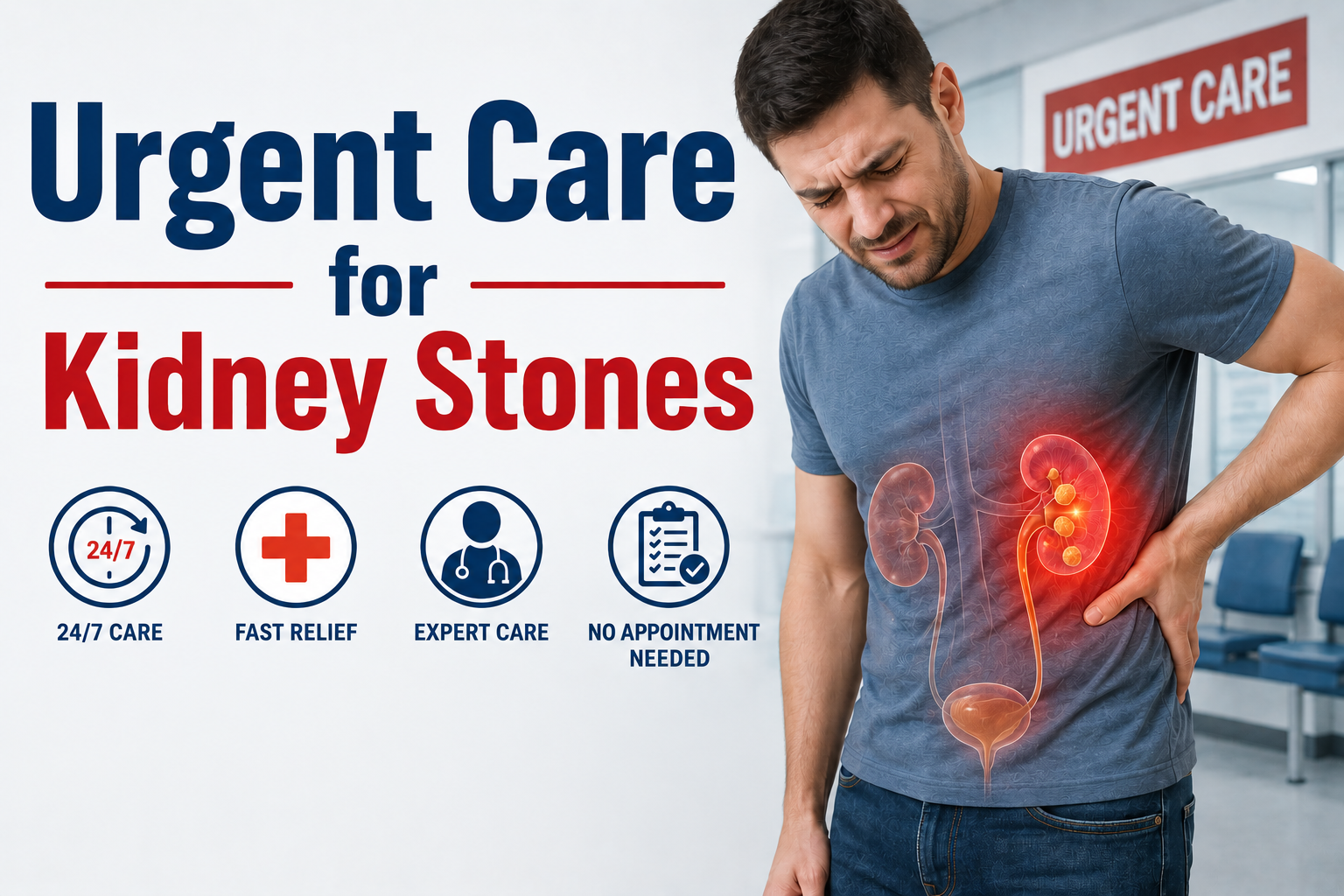
Urgent care for kidney stones can be the fastest, most affordable way to get pain relief and a diagnosis — but only if your symptoms are mild to moderate.
If you’re doubled over with flank pain, unsure whether this is a kidney stone or something worse, and dreading a multi-hour ER wait, you need a clear answer right now, not a generic explainer.
This guide walks you through exactly which symptoms belong at urgent care, which ones mean you should skip straight to the ER, what treatment actually looks like at each setting, and what it will cost you.
You’ll also find a side-by-side comparison table, real clinical sourcing for every statistic, and a FAQ built around the questions people search most when kidney stone pain hits without warning.
Key Takeaways
- Urgent care can diagnose and manage mild-to-moderate kidney stone pain, but most centers can’t perform a CT scan or surgical stone removal on-site.
- Go to the ER instead if you have a high fever, can’t stop vomiting, can’t urinate at all, or the pain is unbearable despite OTC medication.
- About 1 in 11 people in the U.S. will have a kidney stone at some point in their life, according to the National Institute of Diabetes and Digestive and Kidney Diseases.
- Stones under 5mm usually pass on their own within days to a few weeks with hydration and pain control.
- Urgent care visits typically cost far less than an ER visit for the same symptoms, though exact pricing depends on your insurance and location.
What Counts as Urgent Care for Kidney Stones?
Urgent care centers exist for problems that need same-day attention but aren’t immediately life-threatening. For kidney stones, that means they’re built to assess pain, run basic tests, and start treatment — not to perform advanced imaging or surgery.
A typical urgent care visit for suspected kidney stones includes a physical exam, a urine test to check for blood, and pain or anti-nausea medication if needed. Staff there usually have a primary-care background rather than emergency or urology specialty training. If a procedure or further advice is needed, you typically won’t have immediate access to a specialist.
Kidney Stone Symptoms That Are Safe for Urgent Care
Not every kidney stone needs emergency-level resources. Urgent care is generally appropriate when your symptoms are uncomfortable but controllable.
You’re likely a good candidate for urgent care if:



- Your pain is moderate and manageable with over-the-counter medication, not disabling.
- This is your first suspected stone and you mainly need a diagnosis and direction.
- You have mild, persistent symptoms like frequent urination or dull discomfort rather than acute crisis pain.
- You’re not running a fever, vomiting repeatedly, or unable to urinate at all.
If your pain is manageable and you don’t have fever, vomiting, or difficulty urinating, urgent care is a reasonable first stop. Many clinics offer online check-in to reduce wait times, which matters when you’re already uncomfortable.
Warning Signs That Mean You Need the ER, Not Urgent Care
This is the section that matters most, because going to the wrong place can cost you hours when minutes count.
Warning: Do not drive yourself or wait out these symptoms. Go to the emergency room immediately if you experience any of the following.
| Symptom | Why It’s an ER Emergency |
| High fever or chills | May signal a kidney infection combined with a blocked stone — a combination that can become life-threatening fast |
| Inability to urinate at all | Suggests a complete blockage, which can damage kidney function if untreated |
| Persistent vomiting | You can’t stay hydrated, and dehydration worsens stone complications |
| Severe, unrelenting pain | Pain that doesn’t respond to medication and stops you from functioning needs immediate evaluation |
| You have only one kidney | Any blockage is higher-risk when there’s no backup kidney to compensate |
Go to the ER now if you have fever, severe uncontrolled pain, persistent vomiting, pregnancy, or a single kidney. A kidney infection layered on top of a stone is a particularly serious combination — it can require urgent drainage of the kidney to prevent sepsis.
How Urgent Care Diagnoses and Treats Kidney Stones
Once you’re at urgent care, the visit follows a fairly predictable path designed to confirm what’s happening and get your pain under control.
Initial Assessment
The provider will ask about your pain’s location, when it started, and how it’s changed. Urgent care centers typically focus on diagnosing and managing symptoms related to kidney stones rather than providing treatments to remove large or complex stones. Expect a urine sample to check for blood, since that’s a strong indicator a stone is present.
Pain and Symptom Management
If a stone seems likely, treatment usually centers on comfort and supporting your body’s ability to pass it naturally.
- Pain medication to reduce cramping and sharp pain.
- Anti-nausea medication if you’re feeling sick to your stomach.
- Hydration guidance to help flush the stone through your system.
- A referral to a urologist or imaging center if your case needs follow-up beyond what urgent care can offer.
Urgent Care vs. ER vs. Urologist: Which One Do You Actually Need?
Choosing the right setting comes down to symptom severity and how fast you need specialized care.
| Setting | Best For | Can They CT Scan? | Can They Remove a Stone? | Typical Wait |
| Urgent Care | Mild-moderate pain, first-time symptoms | Rarely | No | Short |
| Emergency Room | Severe pain, fever, vomiting, blockage | Yes | In some cases, via referral | Long, but prioritized by severity |
| Urologist (direct) | Stable patients wanting diagnosis + treatment plan | Often, via referral | Yes — lithotripsy, ureteroscopy, surgery | Same-day to next-day in many practices |
A board-certified urologist is the specialist trained to diagnose and treat kidney stones, while primary care, urgent care, and the ER can only start initial care. If you’re stable and want to avoid an ER bill entirely, calling a urologist’s office directly is often the more efficient path.
What Treatment Looks Like by Stone Size
Stone size drives almost every decision a provider makes about your care.
- Under 5mm: Small stones with minor symptoms can usually pass through the urinary tract without invasive treatment, typically with hydration and OTC or prescribed pain relief.
- 6–7mm: These stones have a lower chance of passing on their own and often require a planned procedure.
- Larger stones or any obstructing stone with fever: This requires urgent decompression, not delay.
Treatment for larger or non-passing stones may include extracorporeal shock wave lithotripsy (sound waves to break up the stone), ureteroscopy, or in rare cases, surgical removal — none of which urgent care facilities perform.
How Much Does Urgent Care for Kidney Stones Cost?
Cost is one of the biggest reasons people choose urgent care over the ER for non-emergency stone symptoms, since ER visits typically carry significantly higher facility fees regardless of what treatment you receive.
Out-of-pocket costs vary widely depending on your insurance plan, location, and whether imaging is needed. As a general rule:
- Urgent care visits are billed similarly to a regular specialist office visit, plus the cost of any tests performed.
- ER visits add a separate facility fee on top of physician charges, which is why even minor ER visits often cost several times more than urgent care.
- A CT scan, if not available on-site at urgent care, will require a separate facility visit and bill.
How to Prevent Kidney Stones From Coming Back?
Once you’ve had one stone, your risk of another goes up — which makes prevention worth taking seriously.
Drinking at least 2 to 3 quarts of fluid per day, mostly water, is the single most consistent recommendation across urology guidance.
- Reduce sodium intake, since high-sodium diets increase calcium concentration in urine.
- Moderate animal protein, which can raise uric acid levels.
- Maintain a healthy weight, since obesity is linked to higher stone risk through changes in urine acidity.
- Ask your doctor about stone-type-specific advice, since calcium, uric acid, and struvite stones each respond to different dietary changes.
FAQ
Can urgent care treat kidney stones?
Yes, for mild to moderate cases. Urgent care can diagnose a likely stone, manage pain and nausea, and guide hydration — but most centers can’t remove a stone or perform a CT scan on-site.
When should I go to the ER instead of urgent care for kidney stones?
Go to the ER if you have a high fever, can’t stop vomiting, can’t urinate at all, or have unbearable pain that doesn’t respond to medication. These can signal infection or a dangerous blockage.
How do you know if you have a kidney stone or something else?
Kidney stone pain typically starts suddenly in the back or side below the ribs and may move toward the lower abdomen or groin as the stone travels. Blood in the urine is a strong supporting sign, though it’s absent in some cases.
Can urgent care do a CT scan for kidney stones?
Most urgent care centers cannot. A CT scan is the most precise diagnostic tool for stones, but it usually requires a referral to a separate imaging facility or the ER.
What will urgent care do for kidney stones?
Expect a physical exam, a urine test, and pain or anti-nausea medication if a stone seems likely. You’ll likely get hydration guidance and a referral if further imaging or treatment is needed.
How long does it take to pass a kidney stone?
Stones under 5mm often pass within days to a few weeks with hydration and pain control. Larger stones may take longer or require a procedure if they don’t pass on their own.
Is it cheaper to go to urgent care or the ER for kidney stones?
Urgent care is generally far less expensive than an ER visit for the same symptoms, since ERs add separate facility fees. Exact costs depend on your insurance plan and whether imaging is required.
The Bottom Line
Urgent care for kidney stones works well when your pain is manageable and you don’t have fever, vomiting, or a complete inability to urinate — in those cases, it’s a faster and cheaper way to get a diagnosis and pain relief than the ER.
But severe pain, fever, or persistent vomiting are signals your body is telling you not to wait, and pushing through them at the wrong facility can cost you both time and your kidney’s long-term function. When in doubt, a quick call to a urologist’s office or telehealth line can help you decide where to go before you commit to a waiting room.
Related Articles
Is Diabetes Genetic? What Science Says About Family Risk
Are Dentists Physicians? Understanding the Difference Between Dentists and Medical Doctors
Is Cheese Gluten-Free? Your Complete Guide to Safe and Unsafe Cheeses
15 Health Benefits of Soursop Leaves: Nutrition, Uses, Tea Recipe, and Safety Guide
Dehydrated and Back Pain: Causes, Symptoms, Treatment, and Prevention