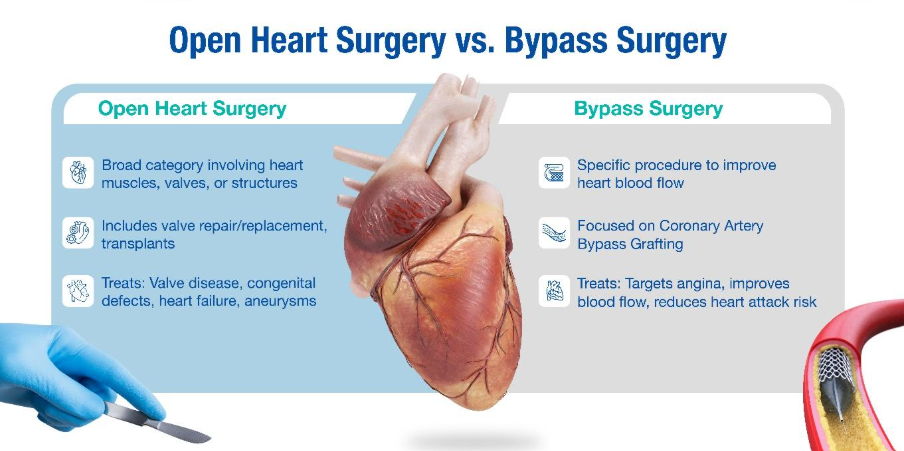
No, a bypass is not exactly the same as open heart surgery, though the two terms are often used interchangeably by patients and even in casual conversation. Open heart surgery is a broad medical category that refers to any operation where the chest is opened to reach the heart directly.
A bypass, more accurately called coronary artery bypass grafting or CABG, is simply one specific procedure that falls under this larger category. So while every bypass surgery is a form of open heart surgery, not every open heart surgery is a bypass. Understanding this distinction helps patients and families ask better questions before a procedure.
What Is Open Heart Surgery?
Open heart surgery is a general term for any procedure where a surgeon opens the chest cavity to operate directly on the heart. It is called “open” because the breastbone, or sternum, is typically divided to give the surgical team full access to the heart muscle, valves, and major blood vessels. This category includes several different procedures, and bypass surgery happens to be one of the most frequently performed among them.
During most open heart surgeries, the patient is connected to a heart-lung bypass machine, which temporarily takes over the job of pumping blood and delivering oxygen while the surgeon works on a heart that has been paused or slowed down. This technology, first used successfully in the 1950s, transformed heart surgery from an extremely rare and risky procedure into a routine, well-established treatment option performed in hospitals worldwide every day.
Why Is It Called “Open”?
The term “open” simply refers to the chest being surgically opened, usually through a vertical incision in the sternum. This gives surgeons a clear, direct view of the heart rather than working through small ports or catheters, which is what happens in less invasive cardiac procedures.
The Heart-Lung Machine’s Role
During a traditional open heart procedure, the heart-lung machine oxygenates the blood and circulates it through the body while the heart itself is temporarily stopped. This allows the surgeon to work on a still, bloodless heart, which improves precision and safety during delicate repairs.
Types of Open Heart Surgery
Open heart surgery is not a single procedure but a category that covers many different operations, each addressing a different heart problem. Below is a table summarizing the most common types performed today.
| Type of Surgery | Main Purpose |
| Coronary Artery Bypass Grafting (CABG) | Reroutes blood flow around blocked coronary arteries |
| Valve Repair or Replacement | Fixes or replaces damaged heart valves |
| Congenital Heart Defect Repair | Corrects structural heart problems present from birth |
| Aortic Aneurysm Repair | Repairs a weakened, bulging section of the aorta |
| Heart Transplant | Replaces a severely damaged heart with a donor heart |
| Maze Procedure | Treats irregular heart rhythms like atrial fibrillation |
Each of these procedures is technically classified as open heart surgery because all of them involve opening the chest to access the heart directly, even though the goals, techniques, and recovery paths differ significantly from one another.


What Is Bypass Surgery, Specifically?
Bypass surgery, or CABG, is performed when one or more coronary arteries become narrowed or blocked, usually due to a buildup of fatty plaque, restricting blood flow to the heart muscle. The surgeon creates a new pathway for blood by grafting a healthy blood vessel taken from elsewhere in the body, allowing blood to bypass the blocked section entirely and reach the heart tissue that was starved of oxygen.
The graft vessel is usually harvested from the patient’s own leg vein, an artery inside the chest wall, or sometimes an artery in the arm. Surgeons choose the source vessel based on factors like the patient’s anatomy, the location of the blockage, and long-term durability of the graft. Once connected, this new vessel takes over blood delivery duties that the blocked artery could no longer perform effectively.
Single, Double, Triple, and Quadruple Bypass
The number attached to a bypass surgery simply refers to how many coronary arteries are being bypassed during the same operation. A double bypass treats two blocked arteries, while a triple or quadruple bypass addresses three or four blockages respectively, all within a single surgical session.
Bypass vs. Open Heart Surgery: A Side-by-Side Comparison
Since bypass surgery is a subset of open heart surgery, comparing the two is a bit like comparing a square to a rectangle. Every square is technically a rectangle, but not every rectangle qualifies as a square, and the same logical relationship applies here.
| Aspect | Open Heart Surgery | Bypass Surgery |
| Definition | Broad category of chest-opening heart procedures | One specific procedure within that category |
| Purpose | Varies by condition being treated | Restores blood flow around blocked arteries |
| Includes | Valve repair, transplants, CABG, and more | Only coronary artery grafting |
| Frequency | Performed for many different heart conditions | One of the most common open heart procedures |
This comparison makes it clear that when someone asks “is a bypass the same as open heart surgery,” the accurate answer is that bypass is always open heart surgery, but open heart surgery is not always a bypass.
Are There Different Types of Bypass Surgery?
Not every bypass procedure follows the traditional model of stopping the heart and using a heart-lung machine. Surgeons today have several techniques available depending on the patient’s condition and the surgical team’s expertise.
Traditional On-Pump CABG
This is the classic approach where the heart is temporarily stopped and the heart-lung machine manages circulation throughout the surgery. It remains the most common method, particularly for complex multi-vessel blockages.
Off-Pump Beating Heart Bypass
In this technique, the surgeon operates on the heart while it continues beating naturally, using specialized stabilizing tools to keep the working area still. This method avoids some risks associated with the heart-lung machine but requires significant surgical skill.
Minimally Invasive Bypass
Some patients qualify for bypass surgery performed through smaller incisions, sometimes assisted by robotic instruments, rather than a full sternotomy. Even though the incisions are smaller, this is still generally classified as open heart surgery because the chest cavity is still entered to reach the heart.
Why the Confusion Between the Two Terms Exists?
The mix-up between bypass and open heart surgery largely comes down to familiarity and repetition. Because CABG is statistically the most frequently performed open heart procedure worldwide, it has become the mental default whenever people hear the phrase “open heart surgery,” even though the phrase technically covers much more ground.
Media coverage, casual conversation, and even some non-medical articles reinforce this pattern by using both terms loosely, which naturally leads patients to assume they mean exactly the same thing.
What Happens During Bypass Surgery?
Understanding the actual steps involved can make the procedure feel less intimidating and clarify exactly why it falls under the open heart surgery umbrella. First, the patient is placed under general anesthesia so they remain completely unconscious and pain-free throughout the operation. The surgeon then makes an incision through the sternum to access the heart directly, which is the defining “open” step of the procedure.
If a traditional on-pump approach is used, the patient is connected to the heart-lung machine at this stage, allowing the heart to be safely stopped while circulation continues artificially. The surgeon then harvests the graft vessel, attaches it above and below the blocked section of the coronary artery, and confirms that blood flow has been successfully restored. Finally, the heart is restarted if it had been stopped, the chest is closed using wires to rejoin the sternum, and the incision is stitched closed.
Recovery: Bypass Compared to Other Open Heart Surgeries
Recovery timelines vary depending on which specific open heart procedure was performed, the patient’s overall health, and whether any complications occurred during surgery. Generally, bypass patients spend several days in the hospital immediately following surgery, often starting in an intensive care unit before moving to a regular recovery ward.
Full recovery at home typically takes a few months, with gradual increases in activity guided by a cardiac rehabilitation program. Valve surgeries and transplant procedures often involve longer hospital stays and more extended monitoring, since these operations tend to carry additional recovery considerations related to the heart adapting to a repaired or entirely new valve or organ.
Risks and Considerations
All open heart surgeries carry certain baseline risks simply because they involve major surgery on a vital, constantly working organ. These general risks include infection, bleeding, irregular heart rhythms, and reactions to anesthesia, regardless of which specific procedure is being performed.
Bypass surgery carries some additional considerations tied to graft failure over time, meaning the newly placed vessel could eventually narrow again, though this is far less common than the original blockage that made surgery necessary. A patient’s age, existing health conditions like diabetes or kidney disease, and overall heart function all influence individual risk levels, which is why every case is evaluated separately by the surgical team beforehand.
Frequently Asked Questions
Is bypass surgery more dangerous than other heart surgeries? Not necessarily. Risk levels depend more on the patient’s overall health and the complexity of their specific case than on which type of open heart surgery is being performed.
Can bypass surgery be done without opening the chest? Even minimally invasive bypass techniques still involve entering the chest cavity, so they are still classified as open heart surgery despite using smaller incisions than traditional methods.
How long does bypass surgery typically take compared to other open heart procedures? A standard bypass surgery usually takes between three and six hours, though this can vary based on how many arteries are being treated and the surgical technique used.
Is minimally invasive bypass still considered open heart surgery? Yes, because the chest is still opened to access the heart directly, even though the incision size and recovery experience may differ from a traditional full sternotomy.
Key Takeaways
Bypass surgery is always a form of open heart surgery, but open heart surgery includes many other procedures beyond bypass alone, such as valve repair, congenital defect correction, and heart transplants.
The confusion between these terms mostly stems from bypass being the most commonly performed procedure in this category. Knowing this distinction helps patients better understand their diagnosis and communicate more clearly with their medical team.
When to Talk to a Doctor
Anyone experiencing chest pain, shortness of breath, or other symptoms of reduced blood flow to the heart should consult a cardiologist promptly for proper evaluation.
If bypass surgery or another form of open heart surgery is recommended, it is worth asking the surgical team which specific procedure is planned, why it was chosen over alternatives, and what the expected recovery process will look like for that particular operation.
Conclusion
So, is a bypass the same as open heart surgery? Not quite. A bypass is one specific and very common type of open heart surgery, not a separate category of its own.
Open heart surgery covers a wide range of procedures designed to treat different heart conditions, while bypass surgery specifically addresses blocked coronary arteries by rerouting blood flow around them.
Understanding this relationship between the two terms can help patients feel more informed and confident when discussing treatment options with their healthcare providers.
Related Posts
Can You Sue for Brain Injury? Legal Rights, Claims & Guide
Is The Brain More Important Than The Heart? Full Comparison Guide
What Do Kidney Stones Look Like in the Toilet? (Full Guide)