

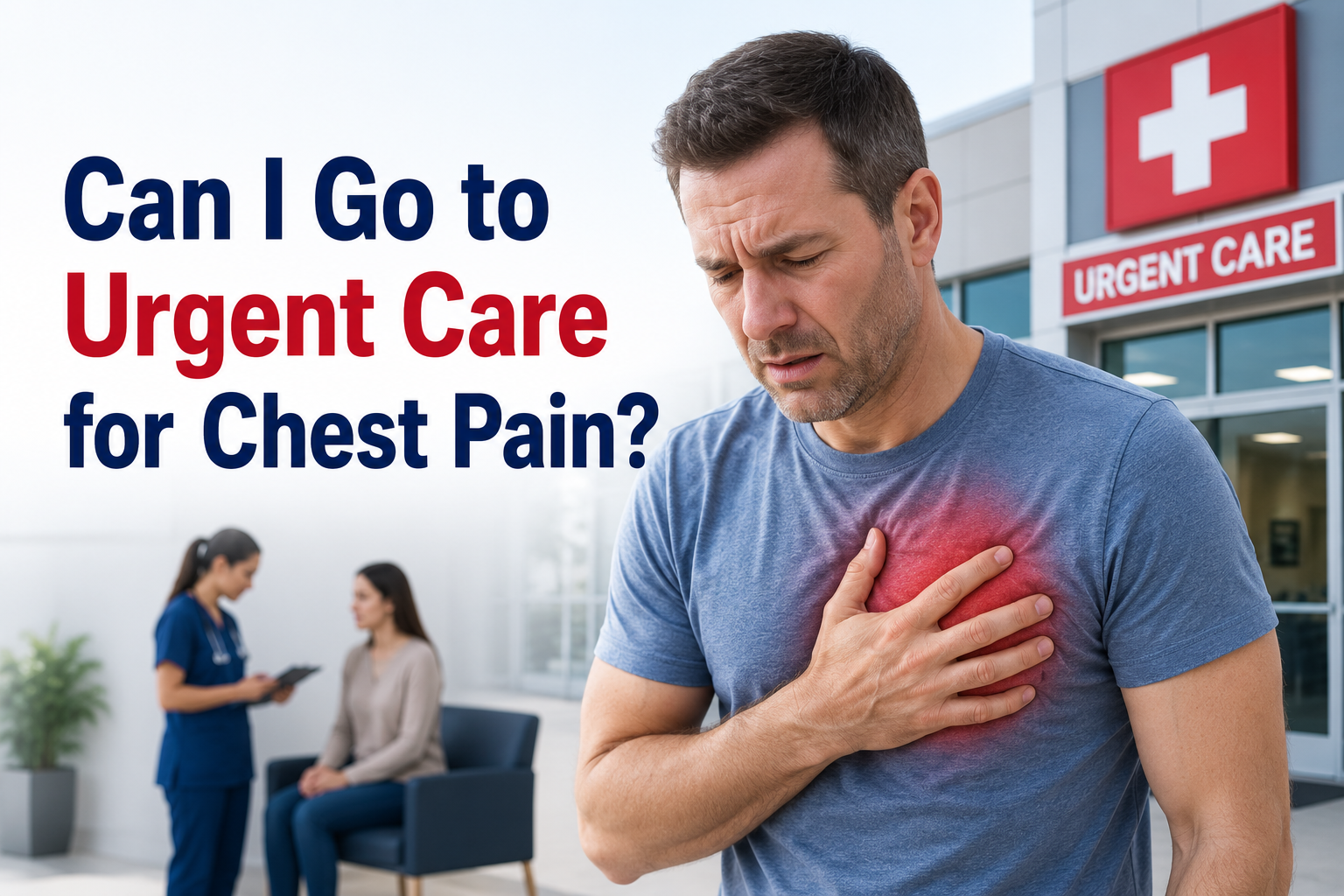
In most cases, the honest answer is no — chest pain is one of the few symptoms where urgent care is not the safest first stop. Asking “can I go to urgent care for chest pain” usually means you are already unsure whether what you feel is serious, and that uncertainty is itself a reason to treat it as an emergency.
Urgent care handles problems that need quick attention but are not life-threatening, while chest pain can signal a heart attack, a blood clot in the lungs, or a torn artery — conditions needing emergency-level equipment within minutes, not hours.
That does not mean every twinge requires a 911 call. Some chest discomfort truly comes from muscle strain, acid reflux, or anxiety, and in a few clearly mild cases a clinician may point you toward urgent care instead. This article covers when chest pain is a true emergency, when urgent care might be reasonable, and what to expect at each facility, so you can decide quickly instead of guessing under pressure.
Key Takeaways
- Chest pain is generally a medical emergency; ERs list it among the conditions they are specifically equipped to handle.
- Call 911 or get to an ER immediately if pain is sudden, severe, crushing, or spreads to the arm, jaw, neck, back, or shoulder.
- Urgent care may suit only mild, stable discomfort with a clear non-cardiac cause, and even then staff may redirect you to the ER.
- ERs run an EKG, blood tests, and imaging within minutes — tools most urgent care centers lack or cannot use fast enough.
- When in doubt, choose the ER. Guessing wrong about chest pain carries far higher risk than an unnecessary visit.
Why Is Chest Pain Usually an Emergency, Not an Urgent Care Case?
Chest pain sits apart from most walk-in complaints because it can be the first sign of a heart attack, with no reliable way to tell from symptoms alone. The sections below cover how urgent care and ERs differ, what urgent care can diagnose, and why every minute matters.
How Urgent Care Differs From Emergency Rooms
Urgent care handles same-day problems that are not immediately dangerous, such as sprains, minor infections, or small cuts. Cleveland Clinic groups chest pain with stroke symptoms, uncontrolled bleeding, and loss of consciousness as belonging in a hospital ER rather than urgent or express care. The core difference is staffing: ERs run around the clock with physicians and full labs, while urgent care is stocked for lower-risk visits.
What Urgent Care Centers Can and Cannot Diagnose
Most urgent care clinics check vital signs and listen to your heart and lungs, and some offer a basic EKG, but they are generally not equipped for the fuller workup a cardiac event requires. A Cleveland Clinic urgent care physician notes that any symptom paired with “severe,” or anything touching airway, breathing, circulation, or disability, points toward the ER instead. Urgent care simply cannot rule out a heart attack with confidence.
Why Time Matters in Cardiac Events
Heart muscle starts to die within minutes of a blocked artery, so the gap between symptom onset and treatment directly affects the damage done. Emergency departments are built around this urgency, with rapid triage, immediate EKGs, and cardiac catheterization teams ready for a true heart attack. Choosing urgent care first, even briefly, adds a detour the heart cannot always afford.
Warning Signs That Mean You Should Call 911 Immediately
Certain patterns of chest pain are strongly linked to heart attacks and belong in an emergency department only. Below are the classic warning signs, how symptoms can differ in women, and the accompanying signals that raise concern.


Classic Heart Attack Symptoms
A heart attack usually causes chest pain lasting more than fifteen minutes, felt as pressure, tightness, squeezing, or aching rather than a sharp stab. The discomfort often spreads to the shoulders, arms, back, neck, jaw, teeth, or upper abdomen. Some people feel severe pain, others only mild discomfort, so a lack of dramatic pain does not rule out a cardiac cause.
Symptoms Specific to Women
Heart attack symptoms can be less obvious in women, older adults, and people with diabetes, sometimes showing up as only nausea, unusual fatigue, or a brief, sharp pain in the neck, arm, or back rather than classic chest pressure. Because these signs are easy to dismiss, women especially are encouraged not to wait out unexplained chest or upper-body discomfort.
Associated Signs (Sweating, Nausea, Dizziness)
Cold sweats, nausea, heartburn-like sensations, lightheadedness, and sudden dizziness frequently accompany a heart attack alongside chest discomfort. Mayo Clinic’s first aid guidance groups these together and advises calling 911 rather than self-diagnosing, since chest pain combined with any of these signs strongly suggests a cardiac emergency.
When Urgent Care Might Be Appropriate
Not every ache in the chest area is dangerous, and a small number of cases genuinely fit what urgent care can handle. This section covers mild non-cardiac discomfort, muscle-related pain, and what happens if a clinician decides you need more care.
Mild, Non-Cardiac Chest Discomfort Examples
Some urgent care providers do treat discomfort clearly linked to digestive issues, panic attacks, or minor injury, especially when pain is mild to moderate, comes with a burning sensation, or starts after a fall or hard cough. In these narrow cases, urgent care can offer faster, lower-cost evaluation than an ER, provided classic emergency warning signs are absent.
Muscle Strain or Costochondritis
Chest wall pain from a pulled muscle or costochondritis, an inflammation of the cartilage connecting ribs to the breastbone, typically worsens with movement, deep breathing, or pressing on the area, and stays fairly localized rather than radiating outward. This pain can reasonably be evaluated at urgent care once serious causes are considered, since it has a clear trigger and rarely comes with sweating, dizziness, or shortness of breath.
When a Doctor May Redirect You From Urgent Care to ER
Even if you start at urgent care with what seems like mild discomfort, a provider who spots any red-flag symptom will typically send you straight to the nearest emergency department, sometimes by ambulance. This safety net exists because chest pain can be deceptive, and urgent care staff are trained to escalate quickly rather than risk missing a heart attack.
What Happens If You Go to the ER for Chest Pain?
Understanding the ER process can make a stressful visit feel more predictable. This section walks through triage, the tests you can expect, and what typically happens next.
Initial Triage and EKG
Chest pain patients are triaged quickly, often ahead of less urgent cases, and an electrocardiogram is usually one of the first tests performed because it can reveal heart attack signs within minutes. GoodRx notes this quick, painless test is a standard early step in evaluating chest pain in the emergency setting.
Blood Tests (Troponin)
Blood work typically follows the EKG, checking markers such as troponin, a protein released when heart muscle is damaged, along with electrolytes and, sometimes, a D-dimer test if a clot is suspected. These results help the team distinguish a true cardiac event from other causes of chest discomfort.
Possible Next Steps (Admission, Imaging)
Depending on initial results, you may also get a chest X-ray or CT scan to check for an aortic tear or pulmonary embolism, according to GoodRx. If results suggest a heart condition, you may start medication right away and be admitted for further cardiac testing, while a clear non-cardiac cause may allow discharge with follow-up instructions.
Urgent Care vs. ER for Chest Pain
The table below summarizes the practical differences so you can see why chest pain leans toward emergency care over a walk-in clinic.
| Factor | Urgent Care | Emergency Room |
| Best suited for | Sprains, minor infections, small cuts, mild reflux-related discomfort | Suspected heart attack, severe or radiating chest pain, breathing trouble |
| On-site diagnostics | Basic exam, sometimes a simple EKG | Full EKG, bloodwork including troponin, X-ray, CT imaging |
| Typical wait time | Roughly 15 to 45 minutes | Longer overall, but chest pain patients are triaged ahead of non-urgent cases |
| Typical cost | Generally $200 to $500 per visit | Generally $2,000 to $5,000 per visit |
| Ability to treat a heart attack | Cannot manage a cardiac event; will refer or call 911 | Equipped with specialists and catheterization teams for immediate treatment |
| Hours | Often extended daytime and weekend hours, not always 24/7 | Open 24 hours a day, every day |
These figures are general ranges from healthcare cost comparisons and vary by location and insurance, so treat them as a rough guide rather than an exact quote.
Risk Factors That Increase Urgency
Certain personal and lifestyle factors make chest pain more likely to be cardiac in origin, helping you decide how quickly to act. The sections below cover age and family history, existing heart conditions, and habits that raise cardiac risk.
Age and Family History
Risk of a cardiac cause for chest pain rises with age, and having a parent or sibling who had heart disease young further raises that risk. Older adults are also more likely to have the less obvious symptom patterns described earlier, part of why Mayo Clinic flags age as a reason to treat new chest discomfort seriously.
Existing Heart Conditions
If you already have a diagnosed heart condition, prior heart attack, or coronary artery disease, new or unusual chest pain should be treated as a possible emergency by default, since your baseline cardiac risk is already elevated. Providers recommend a lower threshold for calling 911 in this group rather than waiting to see if symptoms pass.
Lifestyle Factors (Smoking, Diabetes, High BP)
Smoking, diabetes, high blood pressure, and high cholesterol are established contributors to heart disease risk, and people with these factors should take chest pain especially seriously, even when it feels mild. Diabetes in particular can blunt pain signals, part of why some people with diabetes have a heart attack with little to no chest pain at all.
Frequently Asked Questions
Can urgent care do an EKG for chest pain? Some centers offer a basic EKG, but not all do, and even where available, urgent care generally cannot run the full panel, including troponin blood work and imaging, needed to safely rule out a heart attack.
What if urgent care tells me to go to the ER? This is normal and common. If red-flag symptoms appear during your visit, staff are trained to redirect you to the nearest ER right away, sometimes arranging transport rather than letting you drive.
Is mild chest pain always serious? No, but it is not automatically safe either, since some heart attacks, especially in women, older adults, and people with diabetes, present with only mild or unusual discomfort rather than classic severe pain.
Can anxiety cause chest pain similar to a heart attack? Yes, panic attacks can produce chest tightness, a racing heart, and shortness of breath that closely mimic cardiac symptoms, which is why evaluation is still recommended rather than assuming anxiety is the cause yourself.
How fast should I act if I suspect a heart attack? Immediately. Mayo Clinic advises calling 911 right away rather than waiting to see if symptoms improve, since prompt treatment directly limits the heart damage that occurs.
Conclusion
So, can you go to urgent care for chest pain? In most cases the safer path is the emergency room, especially if pain is severe, spreads beyond the chest, or comes with sweating, nausea, dizziness, or shortness of breath.
Urgent care has a role for clearly mild, non-cardiac discomfort, but it is not designed to rule out a heart attack, and providers there will send you to the ER the moment anything looks concerning. When chest pain catches you off guard, treating it as an emergency first is almost always the safer call than judging its severity yourself.
RELATED POSTS
Can Being Sick Delay Your Period? Causes, Timeline and When to Worry
Are Dill Pickles Good for Diabetics? A Complete Guide
Does the Sauna Help With Acne? Benefits, Risks, and What You Need to Know