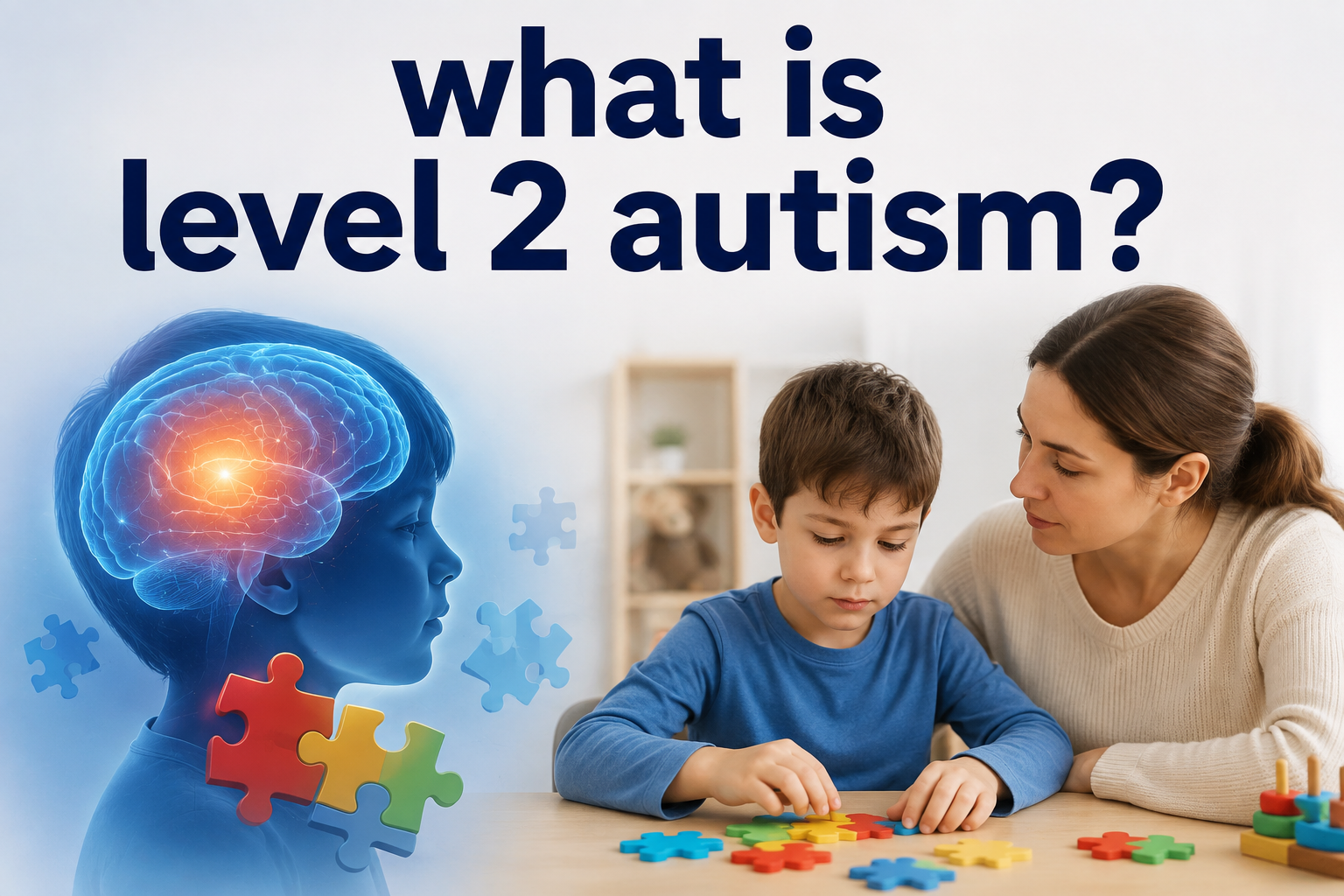
When people search for what is level 2 autism, they are usually trying to understand how it looks in real life rather than just reading a clinical definition.
In simple terms, it describes a person who needs more structured support than someone with mild autism traits, but who is not as dependent on others for daily functioning as someone with Level 3 autism.
Every child or adult at this level is different, and the way symptoms show up can vary widely from one person to another, which is why professional evaluation always plays a central role in confirming the level.
Key Takeaways
- Level 2 autism is the “requiring substantial support” category defined in the DSM-5 classification of Autism Spectrum Disorder.
- It sits between Level 1 (requiring support) and Level 3 (requiring very substantial support).
- Common signs include limited social initiation, repetitive behaviors that are noticeable to others, and difficulty adjusting to changes in routine.
- A licensed psychologist, developmental pediatrician, or psychiatrist is required to confirm the diagnosis and assign the severity level.
- Support usually includes behavioral therapy, speech therapy, occupational therapy, and structured educational accommodations.
- Support needs can shift over time with early intervention and consistent therapy, though the diagnosis itself is generally lifelong.
Understanding the 3 Levels of Autism Spectrum Disorder
The DSM-5 groups autism into three levels based purely on how much support a person needs, not on intelligence or personality. Each level reflects the intensity of social communication difficulty and repetitive behavior a clinician observes during assessment.
Level 1 Autism (Requiring Support)
Level 1 is the mildest classification, sometimes referred to informally as “high-functioning” autism, though clinicians avoid that term today. People at this level can usually communicate in full sentences and manage many daily tasks independently, but they still struggle with the back-and-forth of social conversation and may find it hard to switch between activities without some prompting.
Level 2 Autism (Requiring Substantial Support)
At Level 2, social communication problems are visible even when support is already in place, meaning the person does not simply “outgrow” the difficulty with a little encouragement. Repetitive behaviors and restricted interests appear frequently enough that a casual observer would notice them, and unexpected changes to routine often cause visible distress or difficulty coping.
Level 3 Autism (Requiring Very Substantial Support)
Level 3 represents the most intensive support category. Verbal communication may be very limited or absent, social interaction is minimal even with significant support, and repetitive behaviors or extreme resistance to change can interfere heavily with daily functioning across nearly every setting.
Core Signs and Symptoms of Level 2 Autism
Symptoms at this level generally fall into two broad categories that clinicians look for during an assessment: social communication difficulties and repetitive or restrictive behavior patterns. Both categories must be present for a Level 2 classification to apply.



Social Communication Challenges
A person with Level 2 autism often struggles to start conversations on their own and may respond to social attempts from others in unusual or minimal ways. Eye contact, facial expressions, and understanding of tone or sarcasm can be noticeably reduced, and building peer relationships often takes deliberate coaching rather than happening naturally.
Restricted and Repetitive Behaviors
Repetitive movements such as hand-flapping, rocking, or lining up objects are common and tend to happen often enough that they are easy for others to notice. Interests may be narrow and intense, and the person may insist on following the same routine every day, becoming visibly upset when that routine is interrupted.
Sensory Sensitivities
Many individuals at this level experience heightened or reduced sensitivity to sound, light, texture, or touch. A noisy classroom, a scratchy fabric, or a flickering light can trigger real discomfort, and this sensory reaction is often mistaken for defiance when it is actually an overwhelmed nervous system.
How Level 2 Autism Differs From Level 1 and Level 3?
The three levels exist on a single spectrum, so the line between them is based on intensity and visibility of symptoms rather than completely different traits. Comparing Level 2 side by side with the levels above and below it makes the distinction easier to understand.
Comparison With Level 1
Someone with Level 1 autism can often mask or manage their symptoms well enough that support needs are less obvious to outsiders. Level 2 symptoms, by contrast, remain apparent even when the person already has support systems in place, and independent functioning is noticeably harder without that support.
Comparison With Level 3
Level 3 involves far more limited communication ability, often including minimal or no spoken language, along with much higher dependence on caregivers for basic daily activities. Level 2 individuals typically retain functional speech and more independence in self-care, even though they still need consistent structured support.
| Feature | Level 1 | Level 2 | Level 3 |
| Support needed | Requires support | Requires substantial support | Requires very substantial support |
| Verbal communication | Full sentences, some difficulty with conversation flow | Simple sentences; conversation is limited | Few words or non-verbal |
| Repetitive behaviors | Noticeable in one or two settings | Frequent, obvious to others | Markedly interferes with all functioning |
| Response to routine change | Mild difficulty | Clear distress or difficulty coping | Extreme distress, hard to redirect |
| Independence in daily life | Mostly independent | Needs regular assistance | Highly dependent on caregivers |
How Level 2 Autism Is Diagnosed?
There is no blood test or scan that confirms autism; diagnosis relies entirely on structured behavioral observation and developmental history gathered by a qualified professional over multiple sessions.
Diagnostic Criteria (DSM-5)
Clinicians assess two core domains defined in the DSM-5: persistent deficits in social communication and interaction, and restricted or repetitive patterns of behavior. Both domains must be present from early childhood, even if they were not fully recognized until later, and they must significantly affect daily functioning.
Evaluation Process and Specialists Involved
A full evaluation typically involves a developmental pediatrician, child psychologist, or psychiatrist, often working alongside a speech-language pathologist and occupational therapist. The team gathers information through direct observation, parent interviews, and standardized tools such as the ADOS-2 assessment before assigning a severity level.
Age of Typical Diagnosis
Many children show early signs before age three, though formal diagnosis sometimes happens later, especially if symptoms were mild enough in early childhood to go unnoticed. Earlier identification generally allows intervention to begin sooner, which tends to support better long-term outcomes.
Daily Life and Support Needs
Living with Level 2 autism means daily routines usually work best when they are predictable, and support is woven into school, home, and community settings rather than treated as a one-time fix.
School and Educational Support
Most students at this level benefit from an Individualized Education Program (IEP) or a formal accommodation plan that adjusts classroom expectations, provides visual schedules, and allows sensory breaks when needed. A smaller class size or a dedicated aide often makes a noticeable difference in how well the student engages.
Communication and Therapy Support
Speech therapy helps build functional communication skills, whether that means expanding spoken vocabulary or introducing alternative communication tools when needed. Occupational therapy is frequently paired alongside it to address sensory regulation and fine motor coordination.
Family and Caregiver Support
Parents and caregivers often need their own guidance through parent training programs that teach consistent behavioral strategies to use at home. Respite care and local support groups also play a meaningful role in preventing caregiver burnout over the long term.
Treatment and Intervention Options
There is no single “cure” for autism, and treatment instead focuses on building skills, reducing distress, and improving quality of life through a combination of therapies tailored to the individual.
Behavioral Therapies (e.g., ABA)
Applied Behavior Analysis (ABA) is one of the most widely used interventions, using structured reinforcement techniques to build communication, social, and self-help skills over time. Sessions are typically individualized based on a detailed assessment of the person’s current abilities and goals.
Speech and Occupational Therapy
Speech therapy targets both expressive and receptive language skills, helping the person communicate needs more effectively in daily situations. Occupational therapy works on sensory processing, motor skills, and everyday tasks like dressing or handwriting that can be harder to manage.
Educational Accommodations (IEP/504)
Formal school accommodations ensure the student receives modified instruction, extra time, or specialized support staff as needed under law. These plans are reviewed periodically and adjusted as the student’s needs change over the school years.
Outlook and Long-Term Development
With consistent early intervention, many individuals with Level 2 autism build stronger communication and coping skills over time, and some may need less intensive support as they grow older, though the underlying diagnosis remains part of who they are for life.
Progress looks different for every person, and outcomes depend heavily on how early support begins, how consistent therapy is, and how much the surrounding environment adapts to the individual’s needs rather than expecting the individual to adapt alone.
FAQs
Is Level 2 autism considered “moderate” autism? Yes, it is often informally described as moderate autism because it falls between the mild presentation of Level 1 and the more intensive needs of Level 3.
Can a person with Level 2 autism live independently? Some can with significant support systems in place, though many continue to need help with certain daily tasks, social situations, or decision-making well into adulthood.
Does Level 2 autism require medication? Autism itself has no medication that treats it directly, but doctors sometimes prescribe medication for related issues like anxiety, sleep problems, or attention difficulties.
Can autism severity level change over time? Yes, a person’s support needs can shift with therapy and development, and reassessment sometimes results in a different level being assigned later in life.
What’s the difference between Level 2 autism and Asperger’s? Asperger’s syndrome is no longer used as a separate diagnosis under the DSM-5; it was folded into the single Autism Spectrum Disorder category, with severity now described through levels instead.
Conclusion
Level 2 autism describes a person who needs substantial daily support because of clear social communication difficulties and repetitive behavior patterns that remain visible even with help in place.
Recognizing the signs early and working with qualified specialists for diagnosis and therapy gives individuals at this level the best chance to build skills, gain independence where possible, and thrive in an environment that understands their needs.
Related Articles
Can the Brain Heal Itself? What Science Says
How Much Is a Brain Scan? CT vs MRI Cost Guide
Will a Fatty Liver Cause Back Pain? Symptoms, Causes