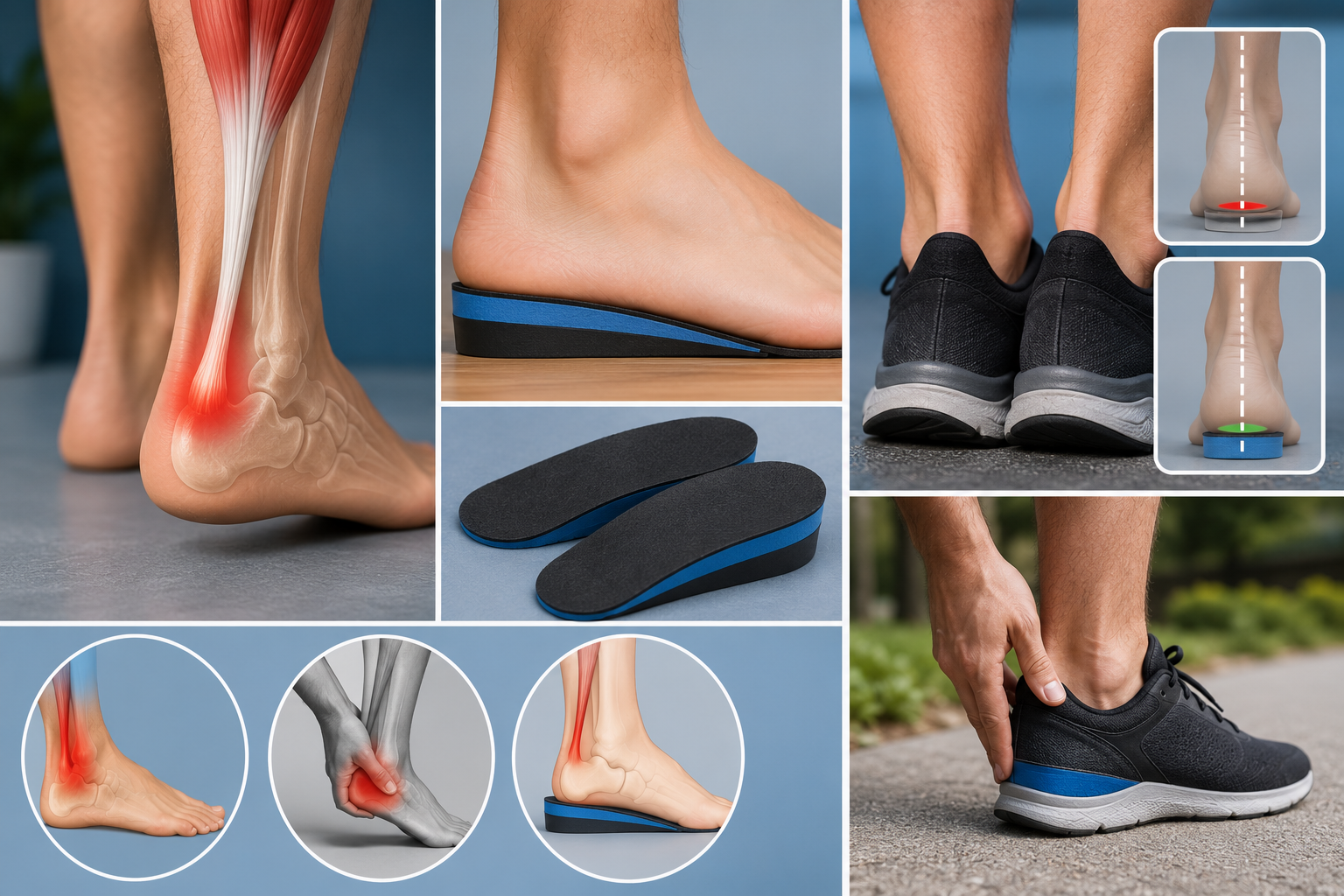
Heel lifts for Achilles tendonitis are small in-shoe inserts that raise the heel to reduce strain on the tendon with every step. Anyone dealing with Achilles pain knows how frustrating it is when walking, climbing stairs, or lacing up running shoes turns into a daily negotiation with discomfort. This guide breaks down what heel lifts actually do, what the clinical research says, how to choose the right one, and how to use them alongside — not instead of — proven rehab exercises.
We’ll also compare real, named products, walk through fitting and height guidance, and flag the situations where a heel lift isn’t enough on its own.
Key Takeaways
- Heel lifts work by reducing ankle dorsiflexion, which lowers strain on the Achilles tendon during walking and standing.
- A 2026 physical therapy clinical practice guideline says clinicians may use heel lifts as a therapeutic tool for midportion Achilles tendinopathy, but the evidence level is limited.
- Firm heel lifts (around 12mm) have outperformed soft, cushioned ones in trials, though results are mixed across studies.
- Heel lifts are best used as a short-term aid alongside calf-strengthening exercise, not as a standalone cure.
- Wearing a lift in only one shoe, or for months without reassessment, can create new imbalances.
What Heel Lifts Do for Achilles Tendonitis
A heel lift is a wedge-shaped insert placed under the heel, inside the shoe. Elevating the heel shortens the distance between the calf muscle and the heel bone, which reduces how far the ankle has to bend upward (dorsiflexion) during walking.
Less dorsiflexion means less stretch and tensile load on the Achilles tendon at the exact point where tendinopathy pain usually shows up — either in the mid-portion of the tendon or where it attaches to the heel bone.
Pro Tip: Achilles tendinopathy comes in two main types — midportion (2 to 6 cm above the heel) and insertional (right where the tendon meets the heel bone). Heel lift height and fit recommendations differ slightly between the two, so knowing which type you have matters before you shop.
- Midportion tendinopathy responds to heel lifts by reducing tendon strain during gait, according to biomechanical research.
- Insertional tendinopathy can benefit from a heel lift that also reduces shoe-heel-counter friction against the back of the heel bone.
- Both types typically also need calf-loading exercise for lasting improvement, not just a passive insert.
What the Research Actually Shows?
This is where a lot of blog content gets vague, so let’s be specific. A 2026 revision of the Achilles tendinopathy clinical practice guideline from the Academy of Orthopaedic Physical Therapy states that clinicians may use heel lifts as a therapeutic tool to temporarily reduce ankle dorsiflexion during activity for individuals with midportion Achilles tendinopathy.
The same guideline draws an important distinction: earlier research found a lack of benefit from viscoelastic, cushioned heel lifts, while a separate trial using firm heel lifts around 12mm in height found more favorable results for reducing the ankle motion needed during daily and sporting activities.



Warning: Not every study agrees. A 2026 randomized controlled trial — the LIFT trial — compared heel lifts to a sham (fake) insert and found the available evidence does not fully substantiate the proposed mechanism that heel lifts work by reducing Achilles tendon length and load. In plain terms: some patients feel real relief, but the “why it works” story isn’t fully settled by high-quality evidence yet.
On the more encouraging side, an earlier randomized trial known as the HEALTHY trial compared heel lifts directly against calf eccentric exercise in 100 patients with midportion Achilles tendinopathy. Results favored heel lifts for both pain relief and function at 12 weeks, and the guideline authors note that compared to tendon loading exercise, heel lifts are easier to adhere to and carry a similarly low level of risk.
A separate case series on insertional Achilles tendinopathy tested 20mm heel lifts and tracked pain and gait changes over two weeks, giving early support for short-term symptom relief in that specific type of tendon pain .
Bottom line: heel lifts have a reasonable, if still developing, evidence base — strong enough that physical therapists routinely recommend them, but not strong enough to call them a guaranteed fix.
Types of Heel Lifts Compared
Not all heel lifts are built the same, and the type you choose changes how much relief you’ll feel. Below is a comparison of common, real products people use for Achilles tendonitis, based on manufacturer specifications and retailer listings.
| Product | Best For | Approx. Lift Height | Material | Typical Price |
| Pro-Tec Achilles Tendon Support | Active use during running, sports, or workouts | Subtle, adjustable via strap | Neoprene, EVA foam pad, CoolMax mesh | ~$20–$30 |
| Tuli’s® Heavy-Duty Heel Cup | Everyday shock absorption plus a mild lift | Up to ~1/4 inch (~6mm) | Molded synthetic rubber | ~$30–$35 per pair |
| Tuli’s® Classic Heel Cup | Daily wear in regular shoes | Slight, less than Heavy-Duty | Softer molded rubber | ~$20–$25 per pair |
| Firm rubber heel wedges (e.g., BML, ScripHessco) | Clinically-directed, precise heights (3mm–12mm) | 3mm to 12mm, sold in set heights | Dense rubber | ~$10–$20 per pair |
| Adjustable stacking heel lifts | Trial-and-error fitting or leg length differences | 1mm to 12mm, customizable | Multi-layer vinyl or foam | ~$15–$25 per pair |
Pros of firm rubber wedges: precise, research-aligned heights; inexpensive; easy to fit under an existing insole. Cons of firm rubber wedges: less cushioning, so they can feel harsh in narrow or already-tight shoes.
Pros of Achilles support wraps like Pro-Tec: combine compression with a mild lift, good for sports use. Cons: the built-in lift is less precise than a dedicated wedge, so it may not match the exact height used in clinical trials.
How to Choose the Right Heel Lift Height and Fit?
Height matters more than brand. Clinical research has tested heights ranging from roughly 6mm up to 20mm, and the right choice depends on your tendon type, shoe style, and how your symptoms respond.
Step 1: Identify your tendinopathy type
Ask whether your pain sits 2–6 cm above the heel bone (midportion) or directly at the back of the heel where the tendon attaches (insertional). This affects both height and product choice.
Step 2: Start conservative
Begin with a lower height, often in the 6–9mm range, especially if you’ve never used a heel lift before. A lift that’s too high can shift pressure to the forefoot and cause new problems.
Step 3: Check both shoes
Always fit a lift into both shoes, even if only one Achilles is painful. An uneven lift on one side alone can tilt your gait and stress the hips, knees, or lower back.
Step 4: Reassess every few weeks
Heel lifts are typically meant as a temporary bridge while you build tendon strength, not a permanent fixture. Revisit the height — and whether you still need it — every 3 to 4 weeks.
Hypothetical Example (for illustration purposes): A recreational runner develops midportion Achilles pain after increasing weekly mileage too quickly. She adds a 9mm firm heel lift to both running shoes and starts a calf-loading program. Within a few weeks, her pain during daily walking decreases enough that she can complete the loading exercises more consistently. By week eight, she gradually removes the lift as calf strength improves. Note: this scenario is illustrative. Actual results vary by tendon severity, footwear, and adherence to exercise.
How to Use Heel Lifts the Right Way?
Using a heel lift correctly matters as much as choosing one.
- Wear it inside the shoe, under the insole — placing it directly under an existing orthotic keeps the heel cup or arch support intact.
- Use it during your most aggravating activities first — walking, standing, or running — rather than all day immediately.
- Pair it with calf-loading exercise, since guidelines describe heel lifts as an adjunct, not a replacement for strengthening work.
- Watch for new symptoms in the forefoot, knee, or hip, which can signal the height is too aggressive.
- Wean off gradually rather than stopping suddenly, especially if you’ve worn a lift for several weeks.
Heel Lifts vs. Other Achilles Tendonitis Treatments
Heel lifts are one tool among several. Here’s how they stack up against other common approaches for Achilles tendonitis.
| Treatment | How It Works | Best Used For | Limitation |
| Heel lifts | Reduces ankle dorsiflexion and tendon strain | Short-term symptom relief, easing daily activity | Evidence on long-term benefit is still developing |
| Calf eccentric/heavy-slow-resistance exercise | Builds tendon capacity and load tolerance | Long-term recovery and prevention | Requires consistency over weeks to months |
| Rigid or elastic taping | Alters foot posture or reduces tendon strain temporarily | Short-term relief during activity | Needs reapplication; skin sensitivity possible |
| Rest and activity modification | Reduces cumulative tendon load | Acute flare-ups | Doesn’t build long-term tendon resilience alone |
According to the same 2026 physical therapy clinical practice guideline, exercise and education are first-line treatments for midportion Achilles tendinopathy, with heel lifts positioned as a supporting option rather than the primary treatment.
Risks and When to See a Doctor
Warning: Heel lifts are generally low-risk, but they aren’t right for every situation. Skip self-treatment and see a doctor or physical therapist if you notice any of the following:
- Sudden, sharp pain or a popping sensation, which can indicate a tendon tear or rupture
- Significant swelling, warmth, or redness around the tendon
- Pain that doesn’t improve after several weeks of conservative care
- Difficulty pushing off on the affected foot when walking
A licensed clinician can confirm your diagnosis with imaging or a physical exam, since heel pain can also stem from plantar fasciitis, bursitis, or other conditions that need different treatment.
Frequently Asked Questions
Q: Do heel lifts really help Achilles tendonitis?
Research suggests they can reduce tendon strain and ease pain for some people, particularly firm lifts around 12mm. Evidence is mixed, so they work best paired with strengthening exercise rather than used alone.
Q: How high should a heel lift be for Achilles tendonitis?
Clinical trials have tested heights from about 6mm to 20mm. Most people start lower, around 6–9mm, and adjust based on comfort and symptom response.
Q: Can I wear a heel lift in only one shoe?
No. Wearing a lift in just one shoe can tilt your gait and create strain elsewhere, including the hips and lower back. Always fit both shoes evenly.
Q: How long should I use heel lifts for Achilles tendonitis?
They’re typically meant as a short-term bridge, often several weeks, while calf strength improves. Reassess the need for a lift every few weeks with your clinician.
Q: Are heel lifts better than eccentric calf exercises?
One randomized trial found heel lifts outperformed eccentric exercise for pain and function at 12 weeks in midportion Achilles tendinopathy, though both approaches have supporting research and are often combined.
Q: What’s the difference between a heel cup and a heel lift?
A heel cup primarily cushions and absorbs shock, with a slight incidental lift. A dedicated heel lift wedge is designed specifically to raise heel height by a set amount.
Q: Can heel lifts help insertional Achilles tendinopathy too?
Yes. Research on 20mm heel lifts for insertional Achilles tendinopathy showed short-term improvements in pain and gait, though this comes from a smaller case series rather than a large trial.
Conclusion
Heel lifts for Achilles tendonitis offer a low-risk, research-supported way to ease daily strain on the tendon while you build lasting strength through exercise.
They work best as one part of a broader plan — not a standalone fix — and the right height depends on your specific symptoms and tendon type.
If pain persists beyond a few weeks or worsens suddenly, loop in a physical therapist or podiatrist to confirm your diagnosis and treatment plan.
RELATED POSTS
How to Get Rid of Crackling Sound in Ear: 9 Proven Fixes
Dehydrated and Back Pain: Causes, Symptoms, Treatment, and Prevention
Growing Pains Massage: Safe Techniques and Natural Ways to Relieve Leg Pain in Children
Can IBS Cause Back Pain? Causes, Symptoms, Treatment, and Relief Tips
Does the Sauna Help With Acne? Benefits, Risks, and What You Need to Know